


Page 133 - IJB-9-3
P. 133
International Journal of Bioprinting      Programmable formaldehyde dehydrogenase for biodegradation formaldehyde


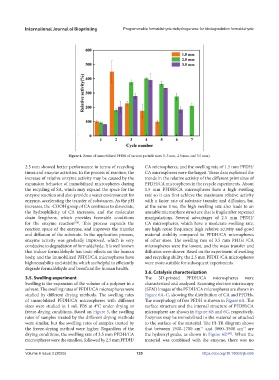
                              Figure 4. Reuse of immobilized PFDH of various particle sizes (1.5 mm, 2.5 mm, and 3.5 mm).

            2.5 mm showed better performance in terms of recycling   CA microspheres, and the swelling rate of 1.5 mm PFDH/
            times and enzyme activities. In the process of reaction, the   CA microspheres were the largest. These data explained the
            increase of relative enzyme activity may be caused by the   trends in the relative activity of the different print sizes of
            expansion behavior of immobilized microspheres during   PFDH/CA microspheres in the recycle experiments. About
            the recycling of SA, which may expand the space for the   1.5 mm PFDH/CA  microspheres  have a high swelling
            enzyme reaction and also provide a water environment for   rate so it can first achieve the maximum relative activity
            enzyme, accelerating the transfer of substances. As the pH   with a faster rate of substrate transfer and diffusion, but
            increases, the -COOH group of CA continues to dissociate,   at the same time, the high swelling rate also leads to an
            the hydrophilicity of CA increases, and the molecular   unstable microsphere structure that is fragile after repeated
            chain lengthens, which provides favorable conditions   manipulations. Several advantages of 2.5 mm PFDH/
            for the enzyme reaction . This process expands the   CA microspheres, which have a moderate swelling rate,
                                 [44]
            reaction space of the enzyme, and improves the transfer   are high reuse frequency, high relative activity and good
            and diffusion of the substrate. In the application process,   material stability compared to PFDH/CA microspheres
            enzyme activity was gradually improved, which is very   of other sizes. The swelling rate of 3.5 mm PFDH /CA
            conducive to degradation of formaldehyde. It is well known   microspheres were the lowest, and the mass transfer and
            that indoor formaldehyde has toxic effects on the human   diffusion were slower. Based on the experiment of swelling
            body, and the immobilized PFDH/CA microspheres have   and recycling ability, the 2.5 mm PFDH /CA microspheres
            high reusability and stability, which are helpful to efficiently   were more suitable for subsequent experiments.
            degrade formaldehyde and beneficial for human health.
                                                               3.6. Catalysis characterization
            3.5. Swelling experiment                           The   3D-printed  PFDH/CA    microspheres  were
            Swelling is the expansion of the volume of a polymer in a   characterized and analyzed. Scanning electron microscopy
            solvent. The swelling rates of PFDH/CA microspheres were   (SEM) images of the PFDH/CA microspheres are shown in
            studied  by  different  drying  methods.  The  swelling  rates   Figure 6A–C, showing the distribution of CA and PFDHs.
            of immobilized PFDH/CA microspheres with different   The morphology of free PFDH is shown in Figure 6A. The
            sizes were studied in 1 mL PBS at 4°C under drying or   surface structure and the internal structure of PFDH/CA
            freeze-drying conditions. Based on Figure 5, the swelling   microsphere are shown in Figure 6B and 6C, respectively.
            rates of samples treated by the different drying methods   Enzymes may be immobilized in the material or attached
            were similar, but the swelling rates of samples treated by   to the surface of the material. The FI-TR diagram shows
            the freeze-drying method were higher. Regardless of the   that between 1500–1700 cm  and 3000–3500 cm  are
                                                                                                         −1
                                                                                       −1
            drying conditions, the swelling rate of 3.5 mm PFDH/CA   the hydroxyl peaks, as shown in Figure 6D . When the
                                                                                                  [45]
            microspheres were the smallest, followed by 2.5 mm PFDH/  material was combined with the enzyme, there was no
            Volume 9 Issue 3 (2023)                        125                          https://doi.org/10.18063/ijb.695

