


Page 134 - IJB-9-3
P. 134
International Journal of Bioprinting      Programmable formaldehyde dehydrogenase for biodegradation formaldehyde


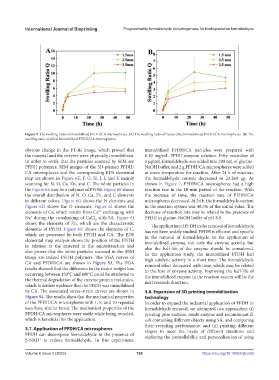
            Figure 5. The swelling ratio of immobilized PFDH/CA microspheres. (A) The swelling ratio of freeze-dried immobilized PFDH/CA microspheres. (B) The
            swelling ratio of dried immobilized PFDH/CA microspheres.

            obvious change in the FT-IR image, which proved that   immobilized PFDH/CA particles were prepared with
            the material and the enzyme were physically immobilized.   0.19 mg/mL PFDH enzyme solution. Fifty microliter of
            In order to verify that the particles scanned by SEM are   1 µg/mL formaldehyde was added into 200 mL of glycine-
            PFDH polymers, SEM images of the 3D-printed PFDH/  NaOH buffer, and 2 g PFDH/CA microspheres were added
            CA  microspheres  and the  corresponding EDS  elemental   at room temperature for reaction. After 24 h of reaction,
            map are shown in Figure 6E, F, G, H, I, J, and K mainly   the formaldehyde content decreased to 23.268  μg. As
            scanning for N, O, Ca, Zn, and C. The white particles in   shown in  Figure 7, PFDH/CA microspheres had a high
            the Figure 6E may be a polymer of PFDH. Figure 6F shows   reaction rate in the 10-min period of the reaction. With
            the overall distribution of N, O, Ca, Zn, and C elements   the increase of time, the reaction rate of PFDH/CA
            in different colors. Figure 6G shows the N elements and   microspheres decreased. At 24 h, the formaldehyde content
            Figure 6H shows the O elements.  Figure 6I shows the   in the reaction system was 48.5% of the initial value. The
            elements of Ca, which results from Ca  exchanging with   decrease of reaction rate may be related to the presence of
                                           2+
            Na  during the crosslinking of CaCl  with SA. Figure 6J   PFDH in glycine-NaOH buffer of pH 8.9.
              +
                                          2
            shows the elements of Zn, which are the characteristic   The application of PFDH in the removal of formaldehyde
            elements of PFDH.  Figure  6K shows  the elements of C,   has not been widely studied. PFDH is efficient and specific
            which are possessed by both PFDH and CA. The EDS   in the removal of formaldehyde. In the application of
            elemental map analysis shows the position of the PFDH   immobilized enzyme, not only the enzyme activity, but
            in  relation  to  the  material in  the  microstructure  and   also the half-life of the enzyme should be considered.
            also proves that the white particles scanned in the SEM   In  the  application  study,  the  immobilized  PFDH  had
            image are indeed PFDH polymers. The TGA curves of   high catalytic activity in a short time. The formaldehyde
            CA and PFDH/CA are shown in  Figure S3. The TGA    removal effect decreased with time, which may be related
            results showed that the difference in the major weight loss   to the loss of enzyme activity. Improving the half-life of
            occurring between 150°C and 480°C could be attributed to   the immobilized enzyme in the reaction system will be the
            the thermal degradation of the enzyme protein molecules,   next research direction.
            which is further evidence that the PFDH was immobilized
            by CA. The associated stress–strain curves are shown in   3.8. Expansion of 3D printing immobilization
            Figure S4. The results show that the mechanical properties   technology
            of the PFDH/CA microspheres with 1, 5, and 10 repeated   In order to expand the industrial application of PFDH in
            uses have similar trend. The mechanical properties of the   formaldehyde removal, we attempted two approaches: (i)
            PFDH/CA microspheres were stable while being recycled,   printing pure enzyme, crude enzyme and recombinant E.
            which is beneficial for the application.           coli containing different objects using SA, and comparing
                                                               their recycling performance; and (ii) printing different
            3.7. Application of PFDH/CA microspheres           shapes to meet the needs of different situations and
            PFDH  can  decompose  formaldehyde  in  the  presence  of   exploring the controllability and personalization of using
            β-NAD  to reduce formaldehyde. In this experiment,
                  +
            Volume 9 Issue 3 (2023)                        126                          https://doi.org/10.18063/ijb.695

