


Page 160 - IJB-9-3
P. 160
International Journal of Bioprinting                                LPBF of AKM/PEEK biological composite


            Table 3. Crystallinity of AKM/PEEK composite specimens
                                ω (AKM = 0 wt%)     ω (AKM = 5 wt%)    ω (AKM = 10 wt%)    ω (AKM = 15 wt%)
             ∆H  (J/g)          45.20               37.85              34.45               32.40
               m
             X  (%)             34.77               29.12              26.50               24.92
              c


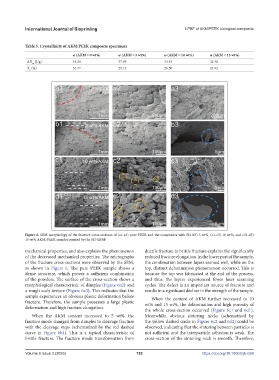
            Figure 6. SEM morphology of the fracture cross-sections of (a1-a3) pure PEEK and the composites with (b1-b3) 5 wt%, (c1-c3) 10 wt%, and (d1-d3)
            15 wt% AKM/PEEK samples printed by the HT-LPBF.

            mechanical properties, and also explains the phenomenon   ductile fracture to brittle fracture explains the significantly
            of the decreased mechanical properties. The micrographs   reduced fracture elongation. In the lower part of the sample,
            of the fracture cross-sections were observed by the SEM,   the combination between layers seemed well, while on the
            as shown in  Figure 6. The pure PEEK sample shows a   top, distinct delamination phenomenon occurred. This is
            dense structure, which proves a sufficient combination   because the top was fabricated at the end of the process,
            of the powders. The surface of the cross-section shows a   and thus, the layers experienced fewer laser scanning
            morphological characteristic of dimples (Figure 6a2) and   cycles. The defect is an important source of fracture and
            a rough scaly texture (Figure 6a3). This indicates that the   results in a significant decline in the strength of the sample.
            sample experiences an obvious plastic deformation before   When the content of AKM further increased to 10
            fracture. Therefore, the sample possesses a large plastic   wt% and 15 wt%, the delamination and high porosity of
            deformation and high fracture elongation.          the whole cross-section occurred (Figure 6c1 and  6d1).
               When the AKM content increased to 5 wt%, the    Meanwhile, obvious sintering necks (schematized by
            fracture mode changed from dimples to cleavage fracture   the yellow dashed circle in Figure 6c2 and 6d2) could be
            with the cleavage steps (schematized by the red dashed   observed, indicating that the sintering between particles is
            curve in  Figure 6b1). This is a typical characteristic of   not sufficient and the interparticle adhesion is weak. The
            brittle fracture. The fracture mode transformation from   cross-section of the sintering neck is smooth. Therefore,


            Volume 9 Issue 3 (2023)                        152                          https://doi.org/10.18063/ijb.699

