


Page 164 - IJB-9-3
P. 164
International Journal of Bioprinting                                LPBF of AKM/PEEK biological composite


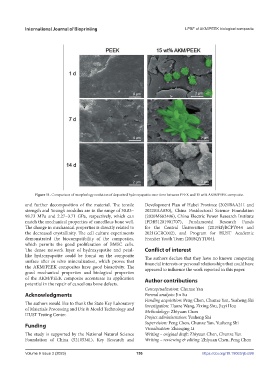
                Figure 11. Comparison of morphology evolution of deposited hydroxyapatite over time between PEEK and 15 wt% AKM/PEEK composite.

            and further decomposition of the material. The tensile   Development Plan of Hubei Province (2021BAA211 and
            strength and Young’s modulus are in the range of 30.83–  2022BAA030), China Postdoctoral Science Foundation
            98.73 MPa and 2.27–3.71 GPa, respectively, which can   (2020M682406), China Electric Power Research Institute
            match the mechanical properties of cancellous bone well.   (PDB51201901707),  Fundamental  Research  Funds
            The change in mechanical properties is directly related to   for  the  Central  Universities  (2019kfyRCPY044  and
            the decreased crystallinity. The cell culture experiments   2021GCRC002), and Program for HUST Academic
            demonstrated the biocompatibility of the composites,   Frontier Youth Team (2018QYTD04).
            which permits the good proliferation of BMSC cells.
            The dense network layer of hydroxyapatite and petal-  Conflict of interest
            like hydroxyapatite could be found on the composite   The authors declare that they have no known competing
            surface after  in vitro mineralization, which proves that   financial interests or personal relationships that could have
            the AKM/PEEK composites have good bioactivity. The   appeared to influence the work reported in this paper.
            good mechanical properties and biological properties
            of the AKM/PEEK composite accentuate its application   Author contributions
            potential in the repair of cancellous bone defects.
                                                               Conceptualization: Chunze Yan
            Acknowledgments                                    Formal analysis: Jin Su
                                                               Funding acquisition: Peng Chen, Chunze Yan, Yusheng Shi
            The authors would like to thank the State Key Laboratory   Investigation: Haoze Wang, Zixing Shu, Jiayi Hou
            of Materials Processing and Die & Mould Technology and   Methodology: Zhiyuan Chen
            HUST Testing Center.                               Project administration: Yusheng Shi

            Funding                                            Supervision: Peng Chen, Chunze Yan, Yusheng Shi
                                                               Visualization: Zhaoqing Li
            The study is supported by the National Natural Science   Writing – original draft: Zhiyuan Chen, Chunze Yan
            Foundation of China (52105341), Key Research and   Writing – reviewing & editing: Zhiyuan Chen, Peng Chen


            Volume 9 Issue 3 (2023)                        156                          https://doi.org/10.18063/ijb.699

