


Page 328 - IJB-9-5
P. 328
International Journal of Bioprinting                              Review of 4D-printed smart medical implants


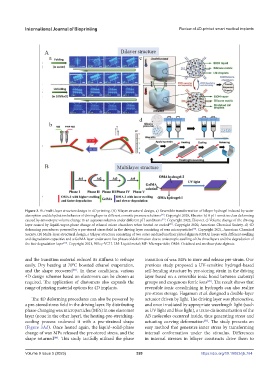
            Figure 3. Bi-/multi-layer structure design in 4D printing. (A) Bilayer structural design, a) Reversible transformation of bilayer hydrogel induced by water
            absorption and dehydration behavior of driving layer in different osmotic pressure solutions . Copyright 2020, Elsevier. b) A pH-sensitive claw deforming
                                                                      [76]
            caused by anisotropic volume change in an aqueous solution under different pH conditions . Copyright 2022, Elsevier. c) Volume change of the driving
                                                                      [77]
            layer caused by liquid–vapor-phase change of ethanol micro chambers when heated or cooled . Copyright 2020, American Chemical Society. d) 4D
                                                                         [81]
            deforming procedures powered by a pre-stored stress field in the driving layer consisting of wax microparticles . Copyright 2021, American Chemical
                                                                                   [84]
            Society. (B) Multi-layer structural design, a trilayer structure consisting of two outer oxidized methacrylated alginate (OMA) layers with different swelling
            and degradation capacities and a GelMA layer underwent five phases of deformation due to anisotropic swelling of the three layers and the degradation of
            the fast-degradation layer . Copyright 2021, Wiley-VCH. LM: Liquid metal; MP: Microparticle; OMA: Oxidized and methacrylate alginate.
                            [89]
            and the transition material reduced its stiffness to reshape   transition of wax MPs to store and release pre-strain. Our
            easily. Dry heating at 70°C boosted ethanol evaporation,   previous study proposed a UV-sensitive hydrogel-based
            and the shape recovered . In these conditions, various   self-bending structure by pre-storing strain in the driving
                                [83]
            4D design schemes based on elastomers can be chosen as   layer based on a reversible ionic bond between carboxyl
            required. The application of elastomers also expands the   groups and exogenous ferric ions . The result shows that
                                                                                         [85]
            range of printing material options for 4D implants.  reversible ionic crosslinking in hydrogels can also realize
                                                               pre-stress storage. Hagaman et al. designed a double-layer
               The 4D deforming procedures can also be powered by   actuator driven by light. The driving layer was photoactive,
            a pre-stored stress field in the driving layer. By distributing   and once irradiated by appropriate wavelength light (such
            phase-changing wax microparticles (MPs) in one elastomer   as UV light and blue light), a trans-cis isomerization of the
            layer (none in the other layer), the heating-pre-stretching-  AB molecules occurred inside, thus generating stress and
            cooling process endowed it with a pre-strained shape   actuating curving deformation . The study presents an
                                                                                        [86]
            (Figure 3Ad). Once heated again, the liquid–solid-phase   easy method that generates inner stress by transforming
            change of wax MPs released the pre-stored stress, and the   internal conformation under the stimulus. Differences
            shape returned . This study tactfully utilized the phase   in internal stresses in bilayer constructs drive them to
                        [84]

            Volume 9 Issue 5 (2023)                        320                         https://doi.org/10.18063/ijb.764

