


Page 21 - IJB-9-6
P. 21
International Journal of Bioprinting CFD analysis for multimaterial bioprinting conditions
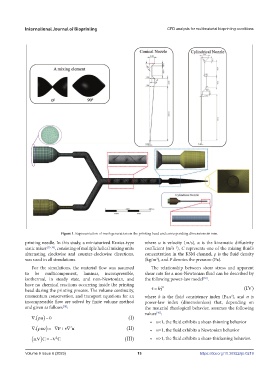
Figure 1. Representation of mesh generation on the printing head and corresponding dimensions in mm.
printing needle. In this study, a miniaturized Kenics-type where u is velocity (m/s), α is the kinematic diffusivity
static mixer [35-38] , consisting of multiple helical mixing units coefficient (m s ), C represents one of the mixing fluid’s
2 −1
alternating clockwise and counter-clockwise directions, concentration in the KSM channel, ρ is the fluid density
was used in all simulations. (kg/m ), and P denotes the pressure (Pa).
3
For the simulations, the material flow was assumed The relationship between shear stress and apparent
to be multicomponent, laminar, incompressible, shear rate for a non-Newtonian fluid can be described by
isothermal, in steady state, and non-Newtonian, and the following power-law model .
[39]
have no chemical reactions occurring inside the printing n
head during the printing process. The volume continuity, k (IV)
momentum conservation, and transport equations for an where k is the fluid consistency index (Pa.s ), and n is
n
incompressible flow are solved by finite volume method power-law index (dimensionless) that, depending on
and given as follows : the material rheological behavior, assumes the following
[38]
values :
[40]
. u 0 (I)
• n<1, the fluid exhibits a shear-thinning behavior
. uu P v 2 u (II) • n=1, the fluid exhibits a Newtonian behavior
u. C– 2 C (III) • n>1, the fluid exhibits a shear-thickening behavior.
Volume 9 Issue 6 (2023) 13 https://doi.org/10.36922/ijb.0219

