


Page 25 - IJB-9-6
P. 25
International Journal of Bioprinting                        CFD analysis for multimaterial bioprinting conditions


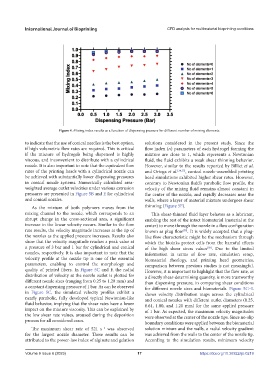
                          Figure 4. Mixing index results as a function of dispensing pressure for different number of mixing elements.

            to indicate that the use of conical needles is the best option,   solutions considered in the present study. Since the
            if high volumetric flow rates are required. This is critical   flow index (n) parameters of each hydrogel forming the
            if the mixture of hydrogels being dispensed is highly   mixture are close to 1, which represents a Newtonian
            viscous, and inconvenient to distribute with a cylindrical   fluid, the fluid exhibits a weak shear thinning behavior.
            nozzle. It is also important to note that the equivalent flow   However, similar to the results reported by Billiet et al.
            rates of the printing heads with a cylindrical nozzle can   and Ortega et al. [34,57] , conical nozzle-assembled printing
            be achieved with substantially lower dispensing pressures   head simulations exhibited higher shear rates. However,
            in conical nozzle systems. Numerically calculated area-  contrary to Newtonian fluid’s parabolic flow profile, the
            weighted average outlet velocities under various extrusion   velocity of the mixing fluid remains almost constant in
            pressures are presented in Figure 5B and E for cylindrical   the center of the nozzle, and rapidly decreases near the
            and conical nozzles.                               walls, where a layer of material mixture undergoes shear
               As the mixture of both polymers moves from the   thinning (Figure 5F).
            mixing channel to the nozzle, which corresponds to an   This shear-thinned fluid layer behaves as a lubricant,
            abrupt  change  in  the  cross-sectional  area,  a  significant   enabling the rest of the intact biomaterial (material at the
            increase in the linear velocity occurs. Similar to the flow   center) to move through the nozzle in a flow configuration
            rate results, the velocity magnitude increases at the tip of   known as plug flow . It is widely accepted that a plug-
                                                                               [58]
            the nozzles as the applied pressure increases. Results also   like flow characteristic might be the mechanism through
            show that the velocity magnitude reaches a peak value at   which the bioinks protect cells from the harmful effects
            a pressure of 3 bar and 1 bar for cylindrical and conical   of the high shear stress values . Due to the limited
                                                                                         [58]
            nozzles, respectively. It is also important to note that the   information  in  terms  of  flow  rate,  simulation  setup,
            velocity profile at the nozzle tip is one of the essential   biomaterial rheology, and printing head geometries,
            parameters, enabling to control the morphology and   comparison between previous studies is not meaningful.
            quality of printed fibers. In  Figure 5C  and F, the radial   However, it is important to highlight that the flow rate, as
            distribution of velocity at the nozzle outlet is plotted for   a directly shear-determining quantity, is more trustworthy
            different nozzle sizes (ranging from 0.25 to 1.20 mm) and   than dispensing pressure, in comparing shear conditions
            a constant dispensing pressure of 1 bar. As can be observed   for different nozzle sizes and biomaterials.  Figure 5G–L
            in  Figure 5C, the simulated velocity profiles exhibit a   shows velocity distribution maps across the cylindrical
            nearly parabolic, fully developed typical Newtonian-like   and conical nozzles with different outlet diameters (0.25,
            fluid behavior, implying that the shear rates have a lower   0.61, 1.00, and 1.20 mm) for the same applied pressure
            impact on the mixture viscosity. This can be explained by   of 1 bar. As expected, the maximum velocity magnitudes
            the low shear rate values, aroused during the deposition   were observed at the center of the nozzle tips. Since no-slip
            process for all considered cases.
                                                               boundary conditions were applied between the biomaterial
               The maximum shear rate of 521 s  was observed   solution mixture and the walls, a radial velocity gradient
                                             −1
            for the largest nozzle diameter. These results can be   was achieved from the walls to the center of the nozzle tip.
            attributed to the power-law index of alginate and gelation   According  to  the simulation  results,  minimum  velocity

            Volume 9 Issue 6 (2023)                         17                        https://doi.org/10.36922/ijb.0219

