


Page 28 - IJB-9-6
P. 28
International Journal of Bioprinting                        CFD analysis for multimaterial bioprinting conditions


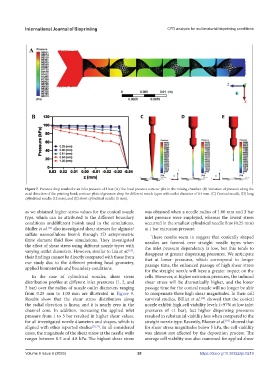
            Figure 7. Pressure drop results for an inlet pressure of 1 bar. (A) The local pressure contour plot in the mixing chamber. (B) Variation of pressure along the
            axial direction of the printing head; contour plots of pressure drop for different nozzle types with outlet diameter of 0.4 mm. (C) Conical needle, (D) long
            cylindrical needle (12 mm), and (E) short cylindrical needle (5 mm).

            as we obtained higher stress values for the conical nozzle   was obtained when a needle radius of 1.00 mm and 3 bar
            type, which can be attributed to the different boundary   inlet pressure were employed, whereas the lowest stress
            conditions anddifferent bioink used in the simulations.   occurred in the smallest cylindrical needle flow (0.25 mm)
            Muller et al.  also investigated shear stresses for alginate/  at 1 bar extrusion pressure.
                     [32]
            sulfate  nanocellulose  bioink  through  2D  axisymmetric   These results seem to suggest that conically shaped
            finite element fluid flow simulations. They investigated   needles  are  favored  over  straight  needle  types  when
            the effect of shear stress using different nozzle types with   the inlet pressure dependency is low, but this tends to
            varying outlet diameters. However, similar to Liu et al. ,   disappear at greater dispensing pressures. We anticipate
                                                        [65]
            their findings cannot be directly compared with those from   that at lower pressures, which correspond to longer
            our study due to the different printing head geometry,   passage time, the enhanced passage of high shear stress
            applied biomaterials and boundary conditions.
                                                               for the straight nozzle will have a greater impact on the
               In the case of cylindrical nozzles, shear stress   cells. However, at higher extrusion pressures, the induced
            distribution profiles at different inlet pressures (1, 2, and   shear stress will be dramatically higher, and the lower
            3 bar) over the radius of nozzle outlet diameters ranging   passage time for the conical nozzle will no longer be able
            from 0.25 mm to 1.00 mm are illustrated in  Figure 9.   to compensate these high shear magnitudes. In their cell
            Results show that the shear stress distribution along   survival studies, Billiet et al.  showed that the conical
                                                                                       [34]
            the radial direction is linear, and it is nearly zero in the   nozzle exhibit high cell viability levels (>97% at low inlet
            channel  core.  In  addition,  increasing  the  applied  inlet   pressures of <1 bar), but higher dispensing pressures
            pressure from 1 to 3 bar resulted in higher shear values,   resulted in substantial viability loss when compared to the
            for all investigated nozzle diameters and shapes, which is   straight nozzle type. Recently, Blaeser et al.  showed that
                                                                                                 [66]
            aligned with other reported studies [32,33] . In all considered   for shear stress magnitudes below 5 kPa, the cell viability
            cases, the magnitude of the shear stress at the needle walls   was almost not affected by the deposition process. The
            ranges between 0.5 and 4.8 kPa. The highest shear stress   average cell viability was also examined for applied shear


            Volume 9 Issue 6 (2023)                         20                        https://doi.org/10.36922/ijb.0219

