


Page 24 - IJB-9-6
P. 24
International Journal of Bioprinting                        CFD analysis for multimaterial bioprinting conditions


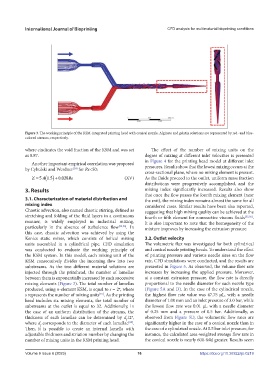
            Figure 3. The working principle of the KSM-integrated printing head with conical nozzle. Alginate and gelatin solutions are represented by red- and blue-
            colored streams, respectively.

            where εindicates the void fraction of the KSM and was set   The  effect  of  the  number  of  mixing  units  on  the
            as 0.87.                                           degree of mixing at different inlet velocities is presented

               Another important empirical correlation was proposed   in Figure 4 for the printing head model at different inlet
            by Cybulski and Werdner  for Re<50:                pressures. Results show that the lowest mixing occurs at the
                                [54]
                                                               cross-sectional plane, where no mixing element is present.
               Z  54.    15.  0 028.  Re          (XV)     As the fluids proceed to the outlet, uniform mass fraction
                                                               distributions were progressively accomplished, and the
            3. Results                                         mixing  index  significantly increased. Results also show
                                                               that once the flow passes the fourth mixing element (near
            3.1. Characterization of material distribution and   the exit), the mixing index remains almost the same for all
            mixing index                                       considered cases. Similar results have been also reported,
            Chaotic advection, also named chaotic stirring, defined as   suggesting that high mixing quality can be achieved at the
            stretching and folding of the fluid layers in a continuous   fourth or fifth element for nonreactive viscous fluids [55,56] .
            manner, is widely employed in industrial mixing,   It is also important to note that the homogeneity of the
            particularly in the absence of turbulence flow [35,36] . In   mixture improves by increasing the extrusion pressure.
            this case, chaotic advection was achieved by using the
            Kenics static mixer, which consists of helical mixing   3.2. Outlet velocity
            units assembled in a cylindrical pipe. CFD simulation   The volumetric flux was investigated for both cylindrical
            was conducted to evaluate the working principle of   and conical nozzle printing heads. To understand the effect
            the KSM system. In this model, each mixing unit of the   of printing pressure and various needle sizes on the flow
            KSM consecutively divides the incoming flow into two   rate, CFD simulations were conducted, and the results are
            substreams. As the two different material solutions are   presented in Figure 5. As observed, the volume flow rate
            injected  through  the  printhead,  the  number  of  lamellae   increases  by  increasing  the  applied  pressure.  Moreover,
            between them is exponentially increased by each successive   at a constant extrusion pressure, the flow rate is directly
            mixing elements (Figure 3). The total number of lamellas   proportional to the needle diameter for each nozzle type
            produced, using n-element KSM, is equal to s = 2 , where   (Figure 5A and D). In the case of the cylindrical nozzle,
                                                    n
            s represents the number of mixing units . As the printing   the highest flow rate value was 47.75 µL, with a needle
                                           [15]
            head includes six mixing elements, the total number of   diameter of 1.00 mm and an inlet pressure of 3.0 bar, while
            substreams  at  the  outlet  is  equal  to  32.  Additionally,  in   the lowest flow rate was 0.01 µL with a needle diameter
            the case of an uniform distribution of the streams, the   of 0.25 mm and a pressure of 0.5 bar. Additionally, as
            thickness of each lamellae can be determined by  d /2 ,   observed from  Figure 5D, the volumetric flow rates are
                                                         n
                                                       f
            where d  corresponds to the diameter of each lamellae .   significantly higher in the case of a conical nozzle than in
                                                        [28]
                  f
            Then, it is possible to create an internal lamella with   the case of a cylindrical nozzle. At 0.5 bar inlet pressure, for
            adjustable thickness and striation number by changing the   instance, the calculated area-weighted average flow rate in
            number of mixing units in the KSM printing head.   the conical nozzle is nearly 600-fold greater. Results seem
            Volume 9 Issue 6 (2023)                         16                        https://doi.org/10.36922/ijb.0219

