


Page 23 - IJB-9-6
P. 23
International Journal of Bioprinting                        CFD analysis for multimaterial bioprinting conditions


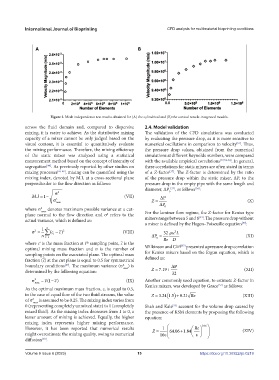
                       Figure 2. Mesh independence test results obtained for (A) the cylindrical and (B) the conical nozzle-integrated models.

            across the fluid domain and, compared to dispersive   2.4. Model validation
            mixing, it is easier to achieve. As the distributive mixing   The validation of the CFD simulations was conducted
            capacity of a mixer cannot be only judged based on the   by evaluating the pressure drop, as it is more sensitive to
            visual contour, it is essential to quantitatively evaluate   numerical oscillations in comparison to velocity . Thus,
                                                                                                      [51]
            the mixing performance. Therefore, the mixing efficiency   the  pressure  drop  values,  obtained  from  the  numerical
            of the static mixer was analyzed using a statistical   simulations at different Reynolds numbers, were compared
            measurement method based on the concept of intensity of   with the available empirical correlations [37,52-54] . In general,
            segregation . As previously reported by other studies on   these correlations for static mixers are often stated in terms
                     [44]
            mixing processes [45-49] , mixing can be quantified using the   of a Z-factor . The Z-factor is determined by the ratio
                                                                         [37]
            mixing index, denoted by M.I, at a cross-sectional plane   of the pressure drop within the static mixer, ΔP, to the
            perpendicular to the flow direction as follows:    pressure drop in the empty pipe with the same length and
                                                               diameter, ΔP  [37] , as follows :
                                                                                    [54]
                         2                                              0
               MI. 1                                (VII)          P
                         2 max                                   Z   P                                  (X)
            where σ 2 max  denotes maximum possible variance at a cut-  0
            plane  normal  to  the  flow  direction  and  σ   refers  to  the   For the laminar flow regime, the Z-factor for Kenics type
                                               2
                                                                                      [44]
            actual variance, which is defined as:              mixers range between 5 and 8 . The pressure drop without
                                                               a mixer is defined by the Hagen–Poiseuille equation :
                                                                                                        [37]
                   1  n
                2
                    c (   c) 2                   (VIII)            32 uL
                                                                            2
                   n   i  1  i                                   P                                     (XI)
                                                                    0
            where c  is the mass fraction at i  sampling point, c is the   Re D  [37]
                                      th
                  i
            optimal  mixing  mass  fraction and  n is  the number  of   Wilkinson and Cliff  presented a pressure drop correlation
            sampling points on the associated plane. The optimal mass   for Kenics mixers based on the Ergun equation, which is
            fraction (c) at the cut plane is equal to 0.5 for symmetrical   defined as:
            boundary conditions . The maximum variance (σ 2 max ) is      P
                             [49]
            determined by the following equation:                 Z  719.    32                        (XII)
                2 max   c( 1 c)                     (IX)    Another commonly used equation, to estimate Z-factor in
                                                                                              [52]
            As the optimal maximum mass fraction, c, is equal to 0.5,   Kenics mixers, was developed by Grace  as follows:
            in the case of equal flow of the two fluid streams, the value   Z  3241.    5.  0 21.  Re  (XIII)
            of σ 2 max  is assumed to be 0.25. The mixing index varies from
            0 (representing completely unmixed state) to 1 (completely   Shah and Kale  account for the volume drop caused by
                                                                           [53]
            mixed fluid). As the mixing index decreases from 1 to 0, a   the presence of KSM elements by proposing the following
            lesser amount of mixing is achieved. Equally, the higher   equation:
            mixing  index  represents  higher  mixing  performance.
            However, it has been reported that numerical results   Z   1   64 06 184  Re  066.     (XIV)
                                                                           .
                                                                                .
            might overestimate the mixing quality, owing to numerical   16
            diffusion .
                   [50]
            Volume 9 Issue 6 (2023)                         15                        https://doi.org/10.36922/ijb.0219

