


Page 27 - IJB-9-6
P. 27
International Journal of Bioprinting                        CFD analysis for multimaterial bioprinting conditions


                                                               related hydrodynamic resistance against the material flow,
                                                               which requires higher dispensing pressures. Applying high
                                                               pressures at the inlets can have a detrimental impact on the
                                                               cell viability, also requiring the use of systems with more
                                                               powerful pumps . Nair  et al.  also observed that the
                                                                                        [61]
                                                                            [28]
                                                               use of a nozzle tip, with a diameter of 0.15 mm and high
                                                               extrusion pressure (40 psi≈ 2.75 bar), resulted in karyolysis
                                                               as well as pyknosis.
                                                               3.4. Shear stress
                                                               The level of shear stress was carefully investigated in terms
                                                               of key printing parameters, such as nozzle type, dispensing
                                                               pressure, and needle diameter. Since the simulations were
                                                               conducted for the entire printing head, the shear stress

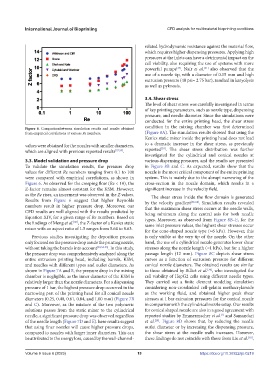
            Figure 6. Comparisonbetween simulation results and results obtained   condition in the  mixing chamber was first determined
            from empirical correlations at various Re numbers.  (Figure 8A). The simulation results showed that using the
                                                               Kenics static mixer inside the printing head does not lead
            values were obtained for the nozzles with smaller diameters,   to a dramatic increase in the shear stress, as previously
                                                                      [28]
            which are aligned with previous reported results [57,59] .  reported . The shear stress distribution was further
                                                               investigated for the cylindrical and conical nozzles at
            3.3. Model validation and pressure drop            various dispensing pressures, and the results are presented
            To validate the simulation results, the pressure drop   in  Figure 8B and  C. As expected, results show that the
            values for different Re numbers ranging from 0.1 to 100   nozzle is the most critical component of the entire printing
            were compared with empirical correlations, as shown in   system. This is mainly due to the abrupt narrowing of the
            Figure 6. As observed for the creeping flow (Re < 10), the   cross-section  in  the  nozzle domain,  which results  in  a
            Z-factor remains almost constant for the KSM. However,   significant increase in the velocity field.
            as the Re rises, an increment was observed in the Z values.   The shear stress inside the flow domain is generated
            Results from  Figure 6  suggest that higher Reynolds   by the velocity gradient [62-64] . Simulation results revealed
            numbers result in higher pressure drop. Moreover, our   that the maximum shear stress occurs at the needle walls,
            CFD results are well aligned with the results predicted by   being minimum along the central axis for both needle
            Equation XIV, for a given range of Re numbers. Based on   types.  Moreover, as  observed from  Figure  8B–E,  for the
            the findings of Meng et al. , the Z-factor of a Kenics static   same inlet pressure values, the highest shear stresses occur
                                [60]
            mixer with an aspect ratio of 1.5 ranges from 5.64 to 8.63.  for the cone-shaped nozzle type (≈6 kPa). However, this
               Previous studies investigating the deposition process   is only visible at the very tip of the nozzle. On the other
            only focused on the pressure drop inside the printing nozzle,   hand, the use of a cylindrical nozzle generates lower shear
            without taking the barrels into account [30,54-55] . In this study,   stresses along the nozzle length (≈1 kPa), but for a higher
            the pressure drop was comprehensively analyzed along the   passage length (12 mm).  Figure 8C depicts shear stress
            entire  extrusion printing  head,  including  barrels,  KSM,   curves as a function of extrusion pressure for different
            and needles with different types and outlet diameters. As   conical nozzle diameters. The obtained results are similar
            shown in Figure 7A and B, the pressure drop in the mixing   to those obtained by Billiet et al. , who investigated the
                                                                                          [34]
            chamber is negligible, as the inner diameter of the KSM is   cell viability of HepG2 cells using different needle types.
            relatively larger than the nozzle diameters. For a dispensing   They  carried  out  a  finite  element  modeling  simulation
            pressure of 1 bar, the highest pressure drop occurred in the   considering non-crosslinked cell-gelatin methacrylamide
            narrowing part of the printing head for all conical nozzle   as the working fluid, and obtained higher peak shear
            diameters (0.25, 0.40, 0.61, 0.84, and 1.00 mm) (Figure 7B   stresses at 1 bar extrusion pressures for the conical nozzle
            and  C). Moreover, as the mixture of the two polymeric   in comparisonwith the cylindrical nozzle setup. Our results
            solutions passes from the static mixer to the cylindrical   for conical shaped nozzle are also in a good agreement with
            needle, a significant pressure drop was observed regardless   reported studies by Emmermacher et al.  and Samandari
                                                                                               [1]
            of the needle length (Figure 7D and E). hese results suggest   et al. .  Figure 8D shows that, by reducing the needle
                                                                   [28]
            that using finer nozzles will cause higher pressure drops,   outlet diameter or by increasing the dispensing pressure,
            compared to nozzles with larger inner diameters. This can   the shear stress at the needle walls increases. However,
                                                                                                           [65]
            be attributed to the energy loss, caused by the wall-channel-  these findings do not coincide with those from Liu et al. ,

            Volume 9 Issue 6 (2023)                         19                        https://doi.org/10.36922/ijb.0219

