


Page 29 - IJB-9-6
P. 29
International Journal of Bioprinting                        CFD analysis for multimaterial bioprinting conditions


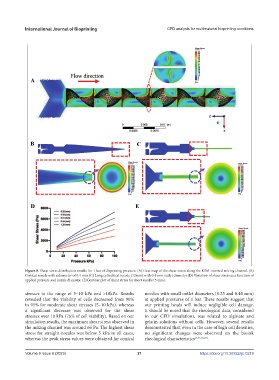
            Figure 8. Shear stress distribution results for 1 bar of dispensing pressure. (A) Heat map of the shear stress along the KSM-inserted mixing channel. (B)
            Conical nozzle with a diameter of 0.4 mm.(C) Long cylindrical nozzle (12mm) with 0.4 mm outlet diameter.(D) Variation of shear stress as a function of
            applied pressure and nozzle diameter. (E)Contour plot of shear stress for short needle (5 mm).

            stresses in the range of 5–10  kPa and >10kPa. Results   needles with small outlet diameters (0.25 and 0.40 mm)
            revealed that the viability of cells decreased from 96%   at applied pressures of 1 bar. These results suggest that
            to 91% for moderate shear stresses (5–10 kPa), whereas   our printing heads will induce negligible cell damage.
            a significant decrease was observed for the shear   It should be noted that the rheological data, considered
            stresses over 10 kPa (76% of cell viability). Based on our   in our CFD simulations, was related to alginate and
            simulation results, the maximum shear stress observed in   gelatin solutions without cells. However, several results
            the mixing channel was around 66 Pa. The highest shear   demonstrated that, even in the case of high cell densities,
            stress for straight nozzles was below 5 kPa in all cases,   no  significant  changes  were  observed  on  the  bioink
            whereas the peak stress values were obtained for conical   rheological characteristics [1,31,66,67] .


            Volume 9 Issue 6 (2023)                         21                        https://doi.org/10.36922/ijb.0219

