


Page 250 - IJB-9-6
P. 250
International Journal of Bioprinting                           3D-Printed GelMA biomaterials in cartilage repair


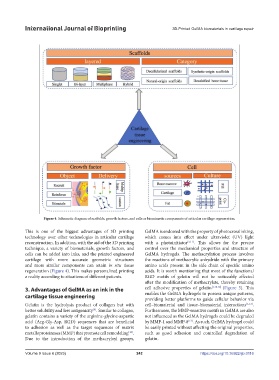
                    Figure 4. Schematic diagram of scaffolds, growth factors, and cells as biomimetic components of articular cartilage regeneration.


            This is one of the biggest advantages of 3D printing   GelMA is endowed with the property of photocrosslinking,
            technology over other technologies in articular cartilage   which comes into effect under ultraviolet (UV) light
            reconstruction. In addition, with the aid of the 3D printing   with a photoinitiator [3,11] . This allows for the precise
            technique, a variety of biomaterials, growth factors, and   control over the mechanical properties and structure of
            cells can be added into inks, and the printed engineered   GelMA hydrogels. The methacrylation process involves
            cartilage with more accurate geometric structures   the reactions of methacrylic anhydride with the primary
            and more similar components can attain  in situ tissue   amino acids present in the side chain of specific amino
            regeneration (Figure 4). This makes personalized printing   acids. It is worth mentioning that most of the functional
            a reality according to situations of different patients.  RGD motifs of gelatin will not be noticeably affected
                                                               after the modification of methacrylate, thereby retaining
            3. Advantages of GelMA as an ink in the            cell adhesive properties of gelatin [1,10,12]  (Figure 5). This
            cartilage tissue engineering                       enables the GelMA hydrogels to possess unique patterns,
                                                               providing better platforms to guide cellular behavior via
            Gelatin is the hydrolysis product of collagen but with   cell–biomaterial and tissue–biomaterial interactions [1,13] .
            better solubility and less antigenicity . Similar to collagen,   Furthermore, the MMP-sensitive motifs in GelMA are also
                                         [9]
            gelatin contains a variety of the arginine-glycine-aspartic   not influenced as the GelMA hydrogels could be degraded
            acid (Arg-Gly-Asp, RGD) sequences that are beneficial   by MMP-1 and MMP-8 . As such, GelMA hydrogel could
                                                                                 [12]
            to adhesion as well as the target sequences of matrix   be easily printed without affecting the original properties,
            metalloproteinases (MMP) that promote cell remodeling .   such as good adhesion and controlled degradation of
                                                        [10]
            Due  to  the  introduction  of  the  methacryloyl  groups,   gelatin.

            Volume 9 Issue 6 (2023)                        242                         https://doi.org/10.36922/ijb.0116

