


Page 248 - IJB-9-6
P. 248
International Journal of Bioprinting                           3D-Printed GelMA biomaterials in cartilage repair


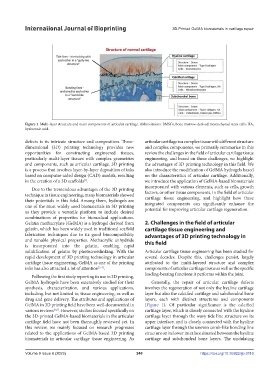
            Figure 1. Multi-layer structure and main components of articular cartilage. Abbreviations: BMSCs, bone marrow-derived mesenchymal stem cells; HA,
            hyaluronic acid.

            defects is its intricate structure and composition. Three-  articular cartilage is a complex tissue with different structure
            dimensional (3D) printing technology provides new   and complex components, we primarily summarize in this
            opportunities for constructing engineered tissues,   review the challenges in the field of articular cartilage tissue
            particularly  multi-layer  tissues  with  complex  geometries   engineering, and based on these challenges, we highlight
            and components, such as articular cartilage. 3D printing   the advantages of 3D printing technology in this field. We
            is a process that involves layer-by-layer deposition of inks   also introduce the modification of GelMA hydrogels based
            based on computer-aided design (CAD) models, resulting   on the characteristics of articular cartilage. Additionally,
            in the creation of a 3D scaffolds .                we introduce the application of GelMA-based biomaterials
                                     [1]
                                                               incorporated with various elements, such as cells, growth
               Due to the tremendous advantages of the 3D printing
            technique in tissue engineering, many biomaterials showed   factors, or other tissue components, in the field of articular
                                                               cartilage tissue engineering, and highlight how these
            their potentials in this field. Among them, hydrogels are   integrated components can significantly enhance the
            one of the most widely used biomaterials in 3D printing   potential for improving articular cartilage regeneration.
            as they provide a versatile platform to include desired
            combinations  of  properties  for  biomedical  applications.
            Gelatin methacrylate (GelMA) is a hydrogel derived from   2. Challenges in the field of articular
            gelatin, which has been widely used in traditional scaffold   cartilage tissue engineering and
            fabrication techniques due to its good biocompatibility   advantages of 3D printing technology in
            and  tunable  physical  properties.  Methacrylic  anhydride   this field
            is incorporated into the gelatin, enabling rapid
            solidification of gelatin by photocrosslinking. With the   Articular cartilage tissue engineering has been studied for
            rapid development of 3D printing technology in articular   several decades. Despite this, challenges persist, largely
            cartilage tissue engineering, GelMA as one of the printing   attributed to the multi-layered structure and complex
            inks has also attracted a lot of attention [2-4] .  components of articular cartilage tissue as well as the specific

               Following the first study reporting its use in 3D printing,   loading-bearing functions it performs within the joint.
            GelMA hydrogels have been extensively studied for their   Generally, the  repair of  articular cartilage defects
            synthesis, characterization, and various applications,   involves the regeneration of not only the hyaline cartilage
            including, but not limited to, tissue engineering, as well as   layer but also the calcified cartilage and subchondral bone
            drug and gene delivery. The attributes and applications of   layers, each with distinct structures and components
            GelMA in 3D printing field have been well-documented in   (Figure 1). Of particular significance is the calcified
            various reviews [5,6] . However, studies focused specifically on   cartilage layer, which is closely connected with the hyaline
            the 3D-printed GelMA-based biomaterials in the articular   cartilage layer through the wavy tide line structure on its
            cartilage field have not been thoroughly reviewed yet. In   upper interface, and is closely connected with the hyaline
            this review, we mainly focused on research progresses   cartilage layer through the uneven comb-like bonding line
            related to the applications of GelMA-based 3D printing   structure on its lower interface situated between the hyaline
            biomaterials in articular cartilage tissue engineering. As   cartilage  and subchondral bone layers. The  undulating


            Volume 9 Issue 6 (2023)                        240                         https://doi.org/10.36922/ijb.0116

