


Page 249 - IJB-9-6
P. 249
International Journal of Bioprinting                           3D-Printed GelMA biomaterials in cartilage repair


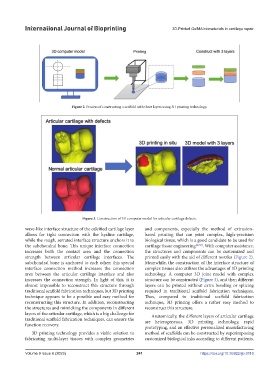
                                Figure 2. Process of constructing a scaffold with three layers using 3D printing technology.


                                    Figure 3. Construction of 3D computer model for articular cartilage defects.

            wave-like interface structure of the calcified cartilage layer   and components, especially the method of extrusion-
            allows  for  tight  connection  with  the  hyaline  cartilage,   based printing that can print complex, high-precision
            while the rough, serrated interface structure anchors it to   biological tissue, which is a good candidate to be used for
            the subchondral bone. This unique interface connection   cartilage tissue engineering [4,7,8] . With computer assistance,
            increases both the contact area and the connection   the structures and components can be customized and
            strength between articular cartilage interfaces. The   printed easily with the aid of different nozzles (Figure 2).
            subchondral bone is anchored to each other; this special   Meanwhile, the construction of the interface structure of
            interface connection method increases the connection   complex tissues also utilizes the advantages of 3D printing
            area  between  the  articular  cartilage  interface  and  also   technology. A computer 3D joint model with complex
            increases the connection strength. In light of this, it is   structure can be constructed (Figure 3), and then different
            almost impossible to reconstruct this structure through   layers can be printed without extra bonding or splicing
            traditional scaffold fabrication techniques, but 3D printing   required  in  traditional  scaffold  fabrication  techniques.
            technique appears to be a possible and easy method for   Thus, compared to traditional scaffold fabrication
            reconstructing this structure. In addition, reconstructing   technique, 3D printing offers a rather easy method to
            the structures and mimicking the components in different   reconstruct this structure.
            layers of the articular cartilage, which is a big challenge for   Anatomically, the different layers of articular cartilage
            traditional scaffold fabrication techniques, can ensure the   are heterogeneous. 3D printing technology, rapid
            function recovery.                                 prototyping, and an effective personalized manufacturing
               3D printing technology provides a viable solution to   method of scaffolds can be constructed by superimposing
            fabricating multi-layer tissues with complex geometries   customized biological inks according to different patients.


            Volume 9 Issue 6 (2023)                        241                         https://doi.org/10.36922/ijb.0116

