


Page 306 - IJB-9-6
P. 306
International Journal of Bioprinting Progress in bioprinted ear reconstruction
Table 2. Continued
Study Aim of study Study Animal Study focus 3D printing Components Printed Printed Cell nature/type Notable post- Assessment Findings Limitations and suggested
setting model (if technique shape material printing of success/ improvements
any) modifications integration
• Chondrocytes grew well on the scaffold with
significant proliferation over time and very
few dead cells were observed at any of the
time points.
• By 14 days, the chondrocytes had spread over
the entire scaffold.
• Histological analysis performed at 6 weeks
showed that the ear-shaped constructs had
preliminarily formed cartilage-like tissue with
typical lacuna structure and strong positive
cartilage ECM staining.
• However, the regenerated tissue showed a
hybrid structure, and some fibrous tissue
could be observed among the regenerated
cartilage regions.
• At 12 weeks, the constructs formed mature
cartilage-like tissue with abundant lacuna
structure and more homogenous cartilage
ECM distribution, despite little fibrous tissue
could still be observed in small areas.
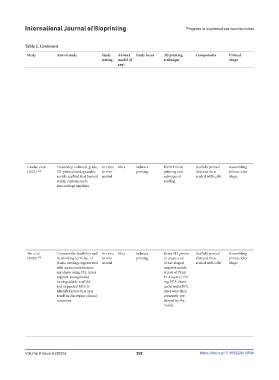
Landau et al. To develop a clinical-grade, In vitro; Mice Indirect BVOH mold Scaffold printed Resembling PCL Chondrocytes and Mold was freeze- Histopathology; • 3D printing was used to create a PCL ear- Small scale
(2021) [23] 3D-printed biodegradable in vivo printing printing and first and then pinna; other MSCs dried and washed micro-CT scan; shaped cartilage for transplants for microtia
auricle scaffold that formed animal subsequent seeded with cells shape three times with mechanical patients.
stable, custom-made seeding water, PBS and testing; electron • The method can also be modified for use in
neocartilage implants. then with a growth microscopy cases of complete lack of auricular cartilage,
medium to create such as anotia and trauma, by integrating
a hydrophilic costal cartilage cells.
environment for • The process is fast and simple for engineering
cell seeding. a medical-grade auricle.
• In vitro assessments showed a significant
advantage for the use of monoculture auricular
cartilage cells, but no significant differences
were observed in the constructs of various cell
types after implantation into mice.
• No significant differences were observed in
lacuna development or collagen-2, elastin,
GAG, and collagen expression between the
two constructs, regardless of cultivation time.
Yin et al. To assess the feasibility and In vitro; Mice Indirect Resin 3D-printer Scaffold printed Resembling A pair Microtia Cells seeded and Histopathology; • All the cartilages generated by different Large animal models are
(2020) [22] in vivo long-term fate of in vivo printing to create a set first and then pinna; other of PGA/ chondrocytes examined for cell mechanical patients’ cells were highly consistent in needed
elastic cartilage regenerated animal of ear-shaped seeded with cells shape PLA layers adhesion 24 h after testing both qualitative and quantitative data,
with an accurate human- negative molds. and a PCL incubation indicating high repeatability and stability of
ear shape using PCL inner A pair of PGA/ layer were the construction technology of cartilages.
support-strengthened PLA layers (150 separately Besides, PCL inner support had no inhibitory
biodegradable scaffold mg PGA fibers pre-shaped effect on cartilage regeneration, maturation,
and expanded MCs to each) and a PCL by the tissue integration, mechanical strength, and
identify factors that may layer were then molds. shape maintenance even after the complete
result in discrepant clinical separately pre- degradation of PCL.
outcomes. shaped by the • The implanted auricle framework could
molds. survive for a long time and successfully
regenerate mature and continuous cartilage
with an accurate human-ear shape.
• After 12 weeks of in vitro culture and 12 months
of implantation in vivo, a porcelain white ear-
shaped cartilage with a shape similarity to the
original mold of 93.02% was formed.
Volume 9 Issue 6 (2023) 298 https://doi.org/10.36922/ijb.0898

