


Page 308 - IJB-9-6
P. 308
International Journal of Bioprinting Progress in bioprinted ear reconstruction
Table 2. Continued
Study Aim of study Study Animal Study focus 3D printing Components Printed Printed Cell nature/type Notable post- Assessment Findings Limitations and suggested
setting model (if technique shape material printing of success/ improvements
any) modifications integration
• The PCL support was completely covered by
the regenerated cartilage with satisfactory
integration.
• Tissue-engineered cartilage shows typical
phenotype of mature elastic cartilage similar
to microtia ear tissue with typical lacuna
structures and strong positive staining of
safranin O, type Il collagen, and Verhoeff-van
Gieson (EVG).
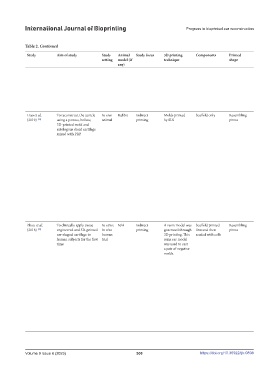
Liao et al. To reconstruct the auricle In vivo Rabbit Indirect Molds printed Scaffold only Resembling Other: Diced cartilage PRP was mixed Histopathology; • The porous, hollow, poly-amide auricular The synthetic, non-
(2019) [24] using a porous, hollow, animal printing by SLS pinna PGLA graft with diced cartilage mechanical mold prepared by 3D printing and packed biodegradable poly-amide
3D-printed mold and membrane and sodium citrate, testing with diced cartilages and PRP graft showed induced a cystic-like
autologous diced cartilage and this paste was appropriate biomechanical properties and reaction around the
mixed with PRP inserted into the maintained it shape, with good chondrocyte implant. It is unclear
printed porous viability and the production of a cartilaginous whether this translates in
scaffold extracellular matrix the clinical setting to the
• It was found that mixing the cartilage formation of a seroma or a
with a PRP improved the viability of the chronic granuloma/foreign
diced cartilage when wrapped in a PLGA body reaction. Another
membrane. limitation of this work is
• At 4 months, the diced cartilage pieces within that we did not explore the
the mold had fused, and the gross appearance possibility of using other
was similar in shape to an auricle. biodegradable materials,
• No complications (e.g., hematoma, seroma, or such as PLGA for the
infection) were observed at the implantation hollow auricle mold.
site during the postoperative period.
• The results of histological staining showed
that the diced cartilages after shaping retained
viable chondrocytes and a complete ECM,
with positive staining for GAGs, collagen
fibers, and elastic fibers, which determine the
biomechanical properties of the cartilage.
Zhou et al. To clinically apply tissue- In vitro; N/A Indirect A resin model was Scaffold printed Resembling PGA, Isolated microtia Expanded microtia Histopathology; • It is possible to successfully design, fabricate, • Small sample of only 5
(2018) [20] engineered and 3D-printed in vivo printing generated through first and then pinna PLA, and chondrocytes cartilage cells were mechanical and re-generate patient-specific external ears patients
ear-shaped cartilage to human 3D printing. This seeded with cells PCL were evenly dropped testing; electron (in human subjects). • Longest follow-up of
human subjects for the first trial resin ear model processed onto the PGA/PLA microscopy; • 12 weeks of tissue expansion were used to only 2.5 years (other
time. was used to cast into the ear layer of the scaffold, other: create a large enough skin flap. A facial flap cases 2–18 months):
a pair of negative scaffold followed by 5-h photography was used to cover the back and the helix rim unknown result after
molds. incubation at 37°C, and visual of the engineered ear graft, which not only complete degradation of
5% CO The inspection of provided sufficient blood supply, but also PCL scaffold (takes 2–4
2.
construct was final clinical protected the graft from extrusion. years)
then cultured in result at 1, 2, 3, • Subsequent surgeries (scar revision) were • Only pilot study: further
chondrogenic 6, 9, 12, 18, 24, conducted for removing the pedicle of skin work necessary to
medium for 12 and 30 months flap at 6 months and repairing scar at 18 translate this into routine
weeks. post-surgery to months, which allowed for tissue biopsies of clinical practices
record swelling, the implanted ear framework. • Optimization and
inflammation • After two weeks, the initial postoperative standardization in
signs, and shape edema slowly reduced, and the shape of the scaffold fabrication, cell
recovery. reconstructed ear, as well as the color of the expansion, and in vitro
MRI (1.5T) to covered skin, gradually recovered. Within 6 cartilage engineering,
trace cartilage months post-implantation, only the basic ear surgical procedures are
regeneration contour was observed, while key auricular still required.
and PCL core structures, such as helix, triangular fossa, • Single center
degradation anti-helix, and cavum conchae, became
gradually distinct after 9 months.
Volume 9 Issue 6 (2023) 300 https://doi.org/10.36922/ijb.0898

