Page 302 - IJB-9-6
P. 302

International Journal of Bioprinting                                Progress in bioprinted ear reconstruction


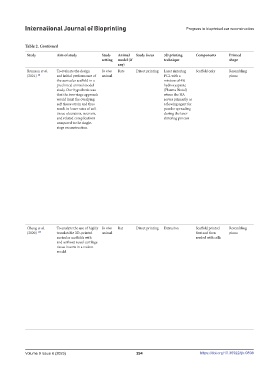
            Table 2. Continued
             Study       Aim of study        Study   Animal   Study focus  3D printing   Components  Printed                     Printed   Cell nature/type  Notable post-  Assessment   Findings                    Limitations and suggested
                                             setting  model (if        technique                   shape                         material                printing       of success/                                  improvements
                                                   any)                                                                                                  modifications  integration
             Brennan et al.   To evaluate the design   In vivo   Rats  Direct printing  Laser sintering   Scaffold only  Resembling   PCL  N/A           Sterilized by   Histopathology;  •  A 3D-printed bioscaffold was developed   H&E was used to assess
             (2021)  [4]  and initial performance of   animal          PCL with a                  pinna                                                 low-temperature   micro-CT scan;   for auricular reconstruction with a realistic   for vascularization.
                         the auricular scaffold in a                   mixture of 4%                                                                     ethylene oxide gas   mechanical   anatomic appearance that meets or exceeds   Quantification of
                         preclinical animal model                      hydroxyapatite                                                                    sterilization prior to  testing  the best outcomes of rib cartilage grafting  angiogenesis has inherent
                         study. Our hypothesis was                     (Plasma Biotal)                                                                   implantation               •  The shape of the construct was durable and   challenges based off how
                         that the two-stage approach                   where the HA                                                                                                   did not experience contraction or distortion   the histology captures the
                         would limit the overlying                     serves primarily as                                                                                            over the course of the experiment.  blood vessels and the lack
                         soft tissue strain and thus                   a flowing agent for                                                                                          •  The scaffold demonstrated robust tissue   of specificity of H&E to
                         result in lower rates of soft                 powder spreading                                                                                               ingrowth and angiogenesis, suggesting it could   stain vessels. So other stains
                         tissue ulceration, necrosis,                  during the laser                                                                                               support the growth of cartilaginous tissue.  should be used.
                         and related complications                     sintering process                                                                                            •  The technique resulted in unparalleled ear   Additional work is
                         compared to the single-                                                                                                                                      appearance in vivo.            necessary to assess the
                         stage reconstruction.                                                                                                                                      •  Ulceration was a problem in all the rats,   potential to cellularize the
                                                                                                                                                                                      regardless of single or two staging.  scaffold with the ultimate
                                                                                                                                                                                    •  Minor superficial ulcers occurred most   goal of gradual replacement
                                                                                                                                                                                      commonly at the lateral (86% of animals)   with a native cartilage
                                                                                                                                                                                      and superior (29% of animals) helix of the   matrix.
                                                                                                                                                                                      scaffold.
                                                                                                                                                                                    •  Promisingly, there were high rates of
                                                                                                                                                                                      improvement in ulceration over time with
                                                                                                                                                                                      only a quarter of models demonstrating
                                                                                                                                                                                      worsening in ulceration over the course of
                                                                                                                                                                                      experimentation. Bolstered by findings of
                                                                                                                                                                                      robust angiogenesis, the authors speculated
                                                                                                                                                                                      that the improvement in wound healing
                                                                                                                                                                                      was secondary to the angiogenesis and
                                                                                                                                                                                      transformation of a bare PCL scaffold to an
                                                                                                                                                                                      integrated, vascularized tissue implant.
                                                                                                                                                                                    •  The porous architecture design may improve
                                                                                                                                                                                      outcomes by reducing skin complications
                                                                                                                                                                                      and allowing increased tissue and vascular
                                                                                                                                                                                      ingrowth to enhance reconstruction and
                                                                                                                                                                                      accelerate healing of skin ulceration.
             Chang et al.   To analyze the use of highly  In vivo   Rat  Direct printing  Extrusion  Scaffold printed   Resembling   PCL   Porcine punch   All scaffolds were   Histopathology;  •  Vascularization was observed in both   No statistically significant
             (2020)  [47]  translatable 3D–printed   animal                          first and then   pinna                                biopsies inserted   sterilized with   micro-CT scan  unseeded and seeded scaffolds, indicating that  difference was observed
                         auricular scaffolds with                                    seeded with cells                                     into scaffolds   ethylene oxide            non-autologous tissue implants do not inhibit  between cartilage-seeded
                         and without novel cartilage                                                                                       to facilitate   Prior to                   vessel formation.              and unseeded scaffolds
                         tissue inserts in a rodent                                                                                        chondrocyte   implantation. Half         •  This technique is readily clinically translatable  in any category of
                         model.                                                                                                            seeding       of the sample was            as it eliminates in vitro requirements and   ulceration. This may be
                                                                                                                                                         cartilage-seeded,            accompanying regulatory burden.  due to the small sample
                                                                                                                                                         with the other             •  The 3D-printed auricles with and without   size or the methods used
                                                                                                                                                         unseeded.                    cartilage inserts were structurally similar to   to measure ulceration.
                                                                                                                                                                                      human ears and measurements remained   The use of additional
                                                                                                                                                                                      consistent.                    immunohistochemistry
                                                                                                                                                                                    •  There was no significant retraction or   might clarify whether
                                                                                                                                                                                      degradation of scaffolds during the   chondrocytes are present
                                                                                                                                                                                      experiment, suggesting resistance to   beyond the limits of the
                                                                                                                                                                                      contractile forces and sustained feasibility of   cartilage punch biopsy and
                                                                                                                                                                                      such implants.                 from which tissue they
                                                                                                                                                                                    •  Micro-CT imaging showed infiltration of soft   arise.
                                                                                                                                                                                      tissue into the pores of hybrid scaffolds.
                                                                                                                                                                                    •  Healing of ulceration was seen in both
                                                                                                                                                                                      conditions, with smaller rates of scaffold-
                                                                                                                                                                                      induced ulceration in cartilage-seeded
                                                                                                                                                                                      scaffolds.


            Volume 9 Issue 6 (2023)                        294                        https://doi.org/10.36922/ijb.0898
   297   298   299   300   301   302   303   304   305   306   307