


Page 297 - IJB-9-6
P. 297
International Journal of Bioprinting                                Progress in bioprinted ear reconstruction


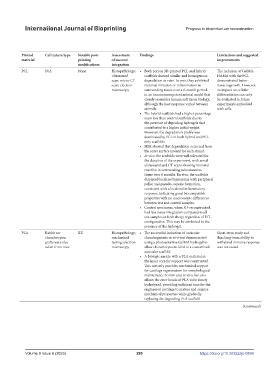
 Study  Aim of study  Study   Animal   Study focus  3D printing   Components  Printed  Printed  Cell nature/type  Notable post-  Assessment   Findings  Limitations and suggested
 setting  model (if   technique  shape  material  printing   of success/                      improvements
 any)                             modifications  integration
 Mukherjee et al.   To assess the degradation   In vitro;  Sheep   Direct printing  Extrusion  Cells in bioink +   Other shape  PCL  N/A  None  Histopathology;  •  Both porous 3D-printed PCL and hybrid   The inclusion of GelMA-
 (2021)  [21]  behavior and tissue   in vivo   (similar   scaffold printed   ultrasound   scaffolds showed similar and homogenous   HAMA with the PCL
 compatibility of hybrid   animal  fascial   together; scaffold   scan; micro-CT   degradation in vitro. In vivo, they exhibited   demonstrated better
 scaffolds (PCL-hydrogel)   anatomy)  only       scan; electron   minimal irritation or inflammation in   tissue ingrowth. However,
 compared to single                              microscopy    surrounding tissue over a 6-month period   its impact on cellular
 material PCL scaffolds in                                     in an immunocompetent animal model that   differentiation can only
 vitro and in vivo. The study                                  closely resembles human soft tissue biology,   be evaluated in future
 wanted to understand                                          although the host response varied between   experiments embedded
 the biological reaction                                       animals.                       with cells.
 to printed scaffolds                                        •  The hybrid scaffolds had a higher percentage
 (independent of stem cells)                                   mass loss than control scaffolds due to
 in an immunocompetent                                         the presence of degrading hydrogels that
 host.                                                         contributed to a higher initial weight.
                                                               However, the degradation profile was
                                                               dominated by PCL in both hybrid and PCL-
                                                               only scaffolds.
                                                             •  SEM showed that degradation occurred from
                                                               the outer surface inward for each strand.
                                                             •  In vivo, the scaffolds were well tolerated for
                                                               the duration of the experiment, with serial
                                                               ultrasound and CT scans showing minimal
                                                               reaction in surrounding subcutaneous
                                                               tissue over 6 months. Ex vivo, the scaffolds
                                                               displayed localized hyperemia with peripheral
                                                               pallor and pseudo-capsule formation,
                                                               consistent with a localized inflammatory
                                                               response, indicating good biocompatible
                                                               properties with no macroscopic differences
                                                               between test and control samples.
                                                             •  Control specimens, when 3D-reconstructed,
                                                               had less tissue integration compared to all
                                                               test samples in both sheep, regardless of PCL
                                                               configuration. This may be attributed to the
                                                               presence of the hydrogel.
 Tang et al.    To explore the use of   In vitro;  Mice  Direct printing  Fused deposition   Scaffold printed   Resembling   PLA  Rabbit ear   XX  Histopathology;  •  The successful induction of auricular   Short-term study and
 (2021)  [15]  3D printing to fabricate   in vivo   modeling   first and then   pinna  chondrocytes;   mechanical   chondrogenesis in vivo was demonstrated   thus long-term ability to
 bioactive artificial   animal  (extrusion)  seeded with cells  grafts were also   testing; electron   using a photosensitive GelMA hydrogel to   withstand immune response
 auricular cartilage using   taken from mice     microscopy    allow chondrocytes to bind to a customized   was not tested.
 chondrocyte-laden GelMA                                       auricular scaffold.
 and PLA for auricle                                         •  A biologic auricle with a PLA material as
 reconstruction.                                               the inner core for support was constructed.
                                                               This not only provides mechanical support
                                                               for cartilage regeneration for morphological
                                                               maintenance in vitro and in vivo, but also
                                                               allows the ester bonds of PLA to be slowly
                                                               hydrolyzed, providing sufficient time for the
                                                               engineered cartilage to mature and acquire
                                                               mechanical properties while gradually
                                                               replacing the degrading PLA scaffold.
                                                                                                         (Continued)


            Volume 9 Issue 6 (2023)                        289                        https://doi.org/10.36922/ijb.0898

