Page 298 - IJB-9-6
P. 298

International Journal of Bioprinting                                Progress in bioprinted ear reconstruction


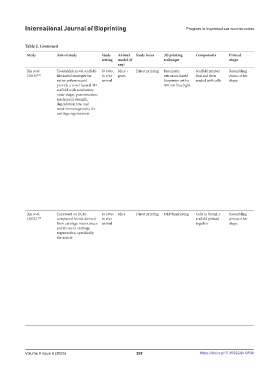
            Table 2. Continued
             Study       Aim of study        Study   Animal   Study focus  3D printing   Components  Printed                     Printed   Cell nature/type  Notable post-  Assessment   Findings                    Limitations and suggested
                                             setting  model (if        technique                   shape                         material                printing       of success/                                  improvements
                                                   any)                                                                                                  modifications  integration
             Xia et al.    To establish novel scaffold-  In vitro;  Mice +   Direct printing  Pneumatic   Scaffold printed   Resembling   Photo-  Goat auricular   After 3D printing,   Histopathology;  •  Photo-crosslinkable gelatin and HA can be   Mechanical strength of the
             (2018) [14]  fabricated strategies for   in vivo   goats  extrusion-based   first and then   pinna; other           curable   cartilage-derived   the scaffolds were   mechanical   fabricated as a porous scaffold with a precise   scaffolds warrants further
                         native polymers and   animal                  bioprinter with a   seeded with cells  shape              hydrogel   chondrocytes  frozen at −80°C for   testing; electron   outer shape, good internal pore structure,   enhancement, and the
                         provide a novel natural 3D                    405 nm blue light.                                        (meth-                  4 h and lyophilized   microscopy  high mechanical strength, and good   feasibility of regenerating
                         scaffold with satisfactory                                                                              acrylic                 for 48 h. The                degradation rate, through photocuring 3D   precisely shaped cartilage
                         outer shape, pore structure,                                                                            anhydride +             scaffolds were then          printing and lyophilization.   needs to be further
                         mechanical strength,                                                                                    gelatinous +            sterilized with            •  The scaffolds combined with chondrocytes   explored.
                         degradation rate, and                                                                                   hyaluronic              ethylene oxide for           successfully regenerated mature cartilage
                         weak immunogenicity for                                                                                 acid)                   subsequent use.              with typical lacunae structure and cartilage-
                         cartilage regeneration.                                                                                                                                      specific ECM both in vitro and in vivo.
                                                                                                                                                                                    •  Chondrocytes were able to adhere to, survive
                                                                                                                                                                                      within, and proliferate effectively in the
                                                                                                                                                                                      scaffolds.
                                                                                                                                                                                    •  In vitro, cartilage-like tissue was successfully
                                                                                                                                                                                      regenerated within 2 weeks, which was faster
                                                                                                                                                                                      than the 4–8 weeks it took to regenerate
                                                                                                                                                                                      cartilage using polyglycolic acid/polyglycolic
                                                                                                                                                                                      acid(PLA/PGA) scaffolds.
                                                                                                                                                                                    •  In immunocompetent large animals,
                                                                                                                                                                                      the 2-week in vitro-engineered cartilage
                                                                                                                                                                                      successfully regenerated stable mature
                                                                                                                                                                                      cartilage with no obvious inflammatory
                                                                                                                                                                                      reaction observed, despite the presence of
                                                                                                                                                                                      abundant residual scaffold. This suggests
                                                                                                                                                                                      that 2 weeks of in vitro culture is optimal for
                                                                                                                                                                                      the current scaffolds to permit autologous in
                                                                                                                                                                                      vivo cartilage regeneration in future clinical
                                                                                                                                                                                      applications, which could greatly decrease
                                                                                                                                                                                      associated patient treatment costs and waiting
                                                                                                                                                                                      times.
             Xie et al.    To present an ECM   In vitro;  Mice  Direct printing  DLP bioprinting  Cells in bioink +   Resembling   Bioink  Porcine       The printed    Histopathology;  •  It was showed that microtia chondrocytes   •  Small print size
             (2022)  [53]  compound bioink derived   in vivo                         scaffold printed   pinna; other                       chondrocytes  auricular constructs  mechanical   extracted from residual ear tissue can be used   •  Repeating the process
                         from cartilage microtissues  animal                         together      shape                                                 were placed in a   testing; electron   to create auricular cartilage for clinical use,   of freezing and thawing
                         and its use in cartilage                                                                                                        complete culture   microscopy  as they had chondrongenic, osteogenic and   the sample and trying
                         regeneration, specifically                                                                                                      medium for 20                adipogenic differentiation potential.  using supercritical
                         the auricle                                                                                                                     days.                      •  Chondrocytes and stem cells were combined   CO  as a disinfectant
                                                                                                                                                                                                                         2
                                                                                                                                                                                      with a hydrogel to create a bioink. This bioink   may improve the
                                                                                                                                                                                      was then used with DLP bioprinting to create   decellularization
                                                                                                                                                                                      auricular constructs that had high elasticity,   method, as the current
                                                                                                                                                                                      high printing accuracy, and low swelling ratio.  method using ethanol
                                                                                                                                                                                    •  Compared with extrusion bioprinting,   and peracetic acid
                                                                                                                                                                                      DLP is highly accurate and may cause less   caused a significant loss
                                                                                                                                                                                      mechanical damage to cells       of GAG content
                                                                                                                                                                                    •  The GelMA+chondrocytes group was
                                                                                                                                                                                      more prone to internal cell death due to
                                                                                                                                                                                      a lack of nutrition, while the cells in the
                                                                                                                                                                                      GelMA+microtissues group fared better,
                                                                                                                                                                                      as the cells could perform intercellular
                                                                                                                                                                                      connections and secret more bioactive
                                                                                                                                                                                      substances
                                                                                                                                                                                    •  After in vitro culture, a large amount of ECM
                                                                                                                                                                                      was deposited, and mature cartilage was
                                                                                                                                                                                      observed to regenerate after subcutaneous
                                                                                                                                                                                      implantation in mice for 12 weeks.


            Volume 9 Issue 6 (2023)                        290                        https://doi.org/10.36922/ijb.0898
   293   294   295   296   297   298   299   300   301   302   303