Page 294 - IJB-9-6
P. 294

International Journal of Bioprinting                                Progress in bioprinted ear reconstruction


            Table 2. Continued
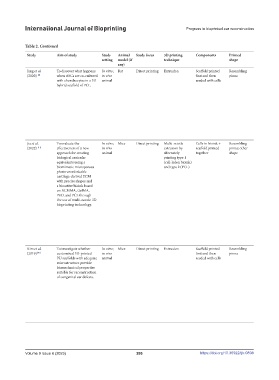
             Study       Aim of study        Study   Animal   Study focus  3D printing   Components  Printed                     Printed   Cell nature/type  Notable post-  Assessment   Findings                    Limitations and suggested
                                             setting  model (if        technique                   shape                         material                printing       of success/                                  improvements
                                                   any)                                                                                                  modifications  integration
             Jang et al.    To discover what happens   In vitro;  Rat  Direct printing  Extrusion  Scaffold printed   Resembling   PCL     Human ASCs and   Incubation in   Histopathology;  •  The proposed hybrid structure exhibited   Unclear sample size
             (2020)  [8]  when ASCs are co-cultured  in vivo                         first and then   pinna                                rabbit articular   culture media at   electron   improved mechanical properties due to the
                         with chondrocytes in a 3D   animal                          seeded with cells                                     chondrocytes  37℃ with 5% CO 2  microscopy  PCL framework and demonstrated reasonable
                         hybrid scaffold of PCL.                                                                                                                                      chondrogenesis in vitro and in vivo.
                                                                                                                                                                                    •  The compressive modulus of the alginate/PCL
                                                                                                                                                                                      hybrid scaffold was found to be around 2.64
                                                                                                                                                                                      ± 0.34 MPa, similar to that of native auricular
                                                                                                                                                                                      tissue.
                                                                                                                                                                                    •  Results suggest that chondrocytes
                                                                                                                                                                                      should be added to the scaffold when it
                                                                                                                                                                                      is implanted in the subcutaneous area
                                                                                                                                                                                      without any surrounding cartilage, as it is
                                                                                                                                                                                      difficult to regenerate cartilage using MSCs
                                                                                                                                                                                      alone without chondrocytes or cartilage
                                                                                                                                                                                      remnants.
             Jia et al.    To evaluate the   In vitro;  Mice  Direct printing  Multi-nozzle   Cells in bioink +   Resembling     Bioink—A   Bama miniature   Two groups of cell-  Histopathology;  •  By using multi-nozzle 3D bioprinting   The feasibility of the
             (2022)  [11]  effectiveness of a new   in vivo            extrusion by   scaffold printed   pinna; other            microporous  pigs’s auricular   laden constructs   micro-CT scan  technology to control the distribution   technology in large animal
                         approach for creating   animal                alternately   together      shape                         photo-    cartilage     were immersed in             of chondrocyte-laden bioink and PCL,   models is still yet to be
                         biological auricular                          printing type 1                                           crosslinkable           a culture medium             microporous auricular equivalents with   optimized and verified by
                         equivalents using a                           (cell-laden bioink)                                       bioactive               for 24 h to dissolve         precise shapes and satisfactory mechanical   further experiments.
                         biomimetic microporous                        and type 2 (PCL)                                          bioink based            PEO to form                  strength were successfully fabricated.
                         photo-crosslinkable                                                                                     on cartilage-           porous structures          •  Mature auricular cartilage tissue with high
                         cartilage-derived ECM                                                                                   derived                                              morphological accuracy, good elasticity,
                         with precise shapes and                                                                                 ECM                                                  numerous cartilage lacunae, and cartilage-
                         a bioactive bioink based                                                                                with the                                             specific ECM deposition was successfully
                         on ACMMA, GelMA,                                                                                        assistance of                                        regenerated in nude mice.
                         PEO, and PCL through                                                                                    GelMA and                                          •  The inclusion of PCL significantly improved
                         the use of multi-nozzle 3D                                                                              PEO.                                                 the shape fidelity of auricular equivalents. The
                         bioprinting technology.                                                                                                                                      modulus of regenerated auricular cartilage
                                                                                                                                                                                      without PCL support was over 65% of native
                                                                                                                                                                                      cartilage, while that of regenerated auricular
                                                                                                                                                                                      cartilage with PCL support was approximately
                                                                                                                                                                                      2.6 times greater than native cartilage.
                                                                                                                                                                                    •  Although the PCL occupied space, it did not
                                                                                                                                                                                      affect the formation of mature cartilage tissue
                                                                                                                                                                                      in the bioink area while providing sufficient
                                                                                                                                                                                      strength and stiffness support.
             Kim et al.    To investigate whether   In vitro;  Mice  Direct printing  Extrusion  Scaffold printed   Resembling   PU        Tonsil-derived   None        Histopathology;  •  3D-printed, implantable ear scaffolds made   Further studies are needed
             (2019) [30]  customized 3D-printed   in vivo                            first and then   pinna                                MSC (for                     micro-CT scan;   of PU are biomimetic, biocompatible, easily   to clarify the long-term
                         PU scaffolds with adequate   animal                         seeded with cells                                     biocompatibility             mechanical    fabricated, and flexible.      behavior of implanted,
                         microstructure provide                                                                                            testing only)                testing; electron  •  The PPU scaffold used in this study was   regular-sized, 3D-printed
                         biomechanical properties                                                                                                                       microscopy    designed to have a specific microstructure in   PPU scaffolds in terms of
                         suitable for reconstruction                                                                                                                                  terms of pore size and uniform pore lattice   shape and elasticity.
                         of congenital ear defects.                                                                                                                                   architecture, which encouraged the ingrowth
                                                                                                                                                                                      of surrounding tissue. In comparison,
                                                                                                                                                                                      the Medpor scaffold had an irregular
                                                                                                                                                                                      microstructure (highly variable pore size and
                                                                                                                                                                                      distribution of pores) that did not allow for
                                                                                                                                                                                      close tissue interactions.
                                                                                                                                                                                    •  Neovascularization was only observed in
                                                                                                                                                                                      PPU scaffolds, indicating that a pore size of
                                                                                                                                                                                      200 mm may be critical for promoting tissue
                                                                                                                                                                                      ingrowth after auricular reconstruction.


            Volume 9 Issue 6 (2023)                        286                        https://doi.org/10.36922/ijb.0898
   289   290   291   292   293   294   295   296   297   298   299