Page 290 - IJB-9-6
P. 290

International Journal of Bioprinting                                Progress in bioprinted ear reconstruction


            Table 2. Continued
             Study       Aim of study        Study   Animal   Study focus  3D printing   Components  Printed                     Printed   Cell nature/type  Notable post-  Assessment   Findings                    Limitations and suggested
                                             setting  model (if        technique                   shape                         material                printing       of success/                                  improvements
                                                   any)                                                                                                  modifications  integration
                                                                                                                                                                                    •  PCL scaffolds maintained good shape
                                                                                                                                                                                      retention both immediately after printing and
                                                                                                                                                                                      after 30 days of in vitro culture.
                                                                                                                                                                                    •  The hybrid ear-shaped construct produced
                                                                                                                                                                                      cartilage-specific components in abundance.
                                                                                                                                                                                    •  400 μm and 800 μm scaffolds are relatively
                                                                                                                                                                                      stiff and inflexible, while 1000 μm and 1200
                                                                                                                                                                                      μm scaffolds allow for more bending when
                                                                                                                                                                                      manipulated by hand. However, using wider
                                                                                                                                                                                      strand spacings also reduces control over the
                                                                                                                                                                                      fine architecture of the structure.
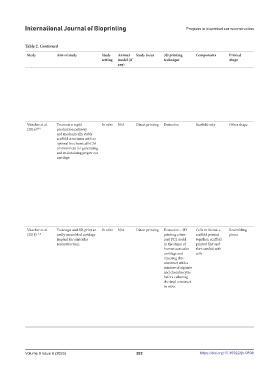
             Visscher et al.   To create a rapid   In vitro  N/A  Direct printing  Extrusion  Scaffold only  Other shape         PCL       Goat mesenchymal  Printing is paused   Histopathology;  •  A novel cage construct consisting of a   No in vivo testing of this
             (2016) [50]  production pathway                                                                                               stem cells,   half-way to insert   mechanical   combined hydrogel and collagen I/III scaffold  method yet
                         and mechanically stable                                                                                           chondrocytes and   a collagen I/III   testing  within a 3D-printed synthetic PCL cage can
                         scaffold structures with an                                                                                       perichondrocytes.  scaffold into the       prevent in vitro scaffold contraction.
                         optimal biochemical ECM                                                                                                         PCL cage. Then             •  Six PCL cage constructs can be produced and
                         environment for generating                                                                                                      after printing,              printed in 2 h with good printing accuracy
                         and maintaining proper ear                                                                                                      hydrogel is added            and minimal oozing effects.
                         cartilage.                                                                                                                      on top of that.            •  Cell-seeded hydrogels showed significant
                                                                                                                                                                                      contraction in vitro, reducing to 15–48% of
                                                                                                                                                                                      their original volume after 28 days of culture
                                                                                                                                                                                      depending on the cell type.
                                                                                                                                                                                    •  Histological evidence of GAG deposition was
                                                                                                                                                                                      present in all scaffolds and internal scaffolds.
                                                                                                                                                                                    •  Chondrocyte- and chondrocytes
                                                                                                                                                                                      perichondrocyte (CP)-seeded scaffolds
                                                                                                                                                                                      produced the most collagen, while adipose-
                                                                                                                                                                                      derived stem cells and chondrocytes had
                                                                                                                                                                                      lower GAG production than other cell types.
                                                                                                                                                                                    •  The Young’s modulus of all scaffolds and
                                                                                                                                                                                      internal scaffolds increased by 50% after 28
                                                                                                                                                                                      days of in vitro culture compared to 14 days
                                                                                                                                                                                      of culture.
             Visscher et al.   To design and 3D-print an   In vitro  N/A  Direct printing  Extrusion – 3D   Cells in bioink +   Resembling   PCL  Chondrocytes   Molds were   Histopathology;  •  It was found that a porous synthetic outer   Long-term in vivo
             (2018)  [51]  easily-assembled cartilage                  printing a two-  scaffold printed   pinna                           from Dutch milk   disinfected with   Mechanical   layer with high mechanical strength was   experiments are required to
                         implant for auricular                         part PCL mold   together; scaffold                                  goats         70% ethanol for 1 h,  testing  needed to withstand forces during in vivo   test preclinical applicability
                         reconstruction.                               in the shape of   printed first and                                               washed with sterile          tissue maturation.
                                                                       human auricular   then seeded with                                                PBS and dried in a         •  An inner “natural” core made of a biomimetic
                                                                       cartilage and   cells                                                             sterile incubator.           environment for cartilage tissue formation
                                                                       injecting this                                                                    All parts were               was an effective way to achieve biointegration.
                                                                       construct with a                                                                  coated with sterile        •  Beads cultured in chondrogenic medium had
                                                                       mixture of alginate                                                               gelatin to block             higher levels of GAGs and type II collagen
                                                                       and chondrocytes                                                                  the pores and                deposition.
                                                                       before culturing                                                                  create a sealed
                                                                       the final construct                                                               mold. Once placed
                                                                       in vitro.                                                                         in proliferation
                                                                                                                                                         medium at
                                                                                                                                                         37°C, the gelatin
                                                                                                                                                         liquefied and left
                                                                                                                                                         the pores, allowing
                                                                                                                                                         for nutrient and
                                                                                                                                                         oxygen exchange
                                                                                                                                                         through the mold
                                                                                                                                                         pores.


            Volume 9 Issue 6 (2023)                        282                        https://doi.org/10.36922/ijb.0898
   285   286   287   288   289   290   291   292   293   294   295