


Page 385 - IJB-9-6
P. 385
International Journal of Bioprinting                               Biomimetic biofabrication of tumors volume


               On the other hand, synthetic polymers such as   with precise size and controlled architecture. Moreover, 3D
            polyethylene  glycol  (PEG)  are  able  to  form  hydrogels   bioprinting enables the construction of tissue models in a
            with tunable mechanical properties, such as stiffness or   high-throughput manner, which is indispensable to meet
            degradation rate, but often lack the ability to recapitulate   the need for more reliable and standardized models for
            the native ECM due to the absence of any motif for cell   anti-cancer drug screening .
                                                                                    [17]
            adhesion. However, synthetic polymers can be engineered
            by chemical functionalization with various bioactive   Indeed, during the last decade, researchers have
            moieties, such as integrin-binding or enzymatically   attempted to reproduce the complexity of the tumor milieu
            degradable (e.g., MMP-cleavable) peptide sequences, to   via 3D bioprinting, building biomimetic 3D in vitro tumor
            enhance the ultimate functionality.                models. Taken together, the capability of using multiple cell
                                                               types (including all the elements that make up the TME)
               Harnessing the advantages of blending naturally   and different biomaterials, along with the possibility to
            derived and synthetic materials, composite inks are   develop a functional vascularization, made 3D bioprinting
            preferred for the fabrication of biomimetic TME models.   an attractive and promising strategy to engineer 3D in vitro
            Nevertheless, the combination of tissue type, material   tumor models.
            ink, and bioprinting technology has offered a challenging
            choice over the possibility of printing functional cancerous   In the following section, the main 3D bioprinting
            models de novo.                                    techniques are briefly described, followed by the discussion
                                                               of the more relevant studies on the development of
            3.2. 3D bioprinting of tumor microenvironments     3D-bioprinted  models  that  resemble  various  TMEs  and
            3D bioprinting is a revolutionizing technique in which   their main features, classified by the bioprinting technique
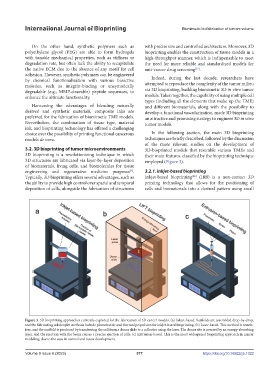
            3D structures are fabricated via layer-by-layer deposition   employed (Figure 3).
            of  biomaterials,  living  cells,  and  biomolecules  for  tissue
            engineering and regenerative medicine purposes .   3.2.1. Inkjet-based bioprinting
                                                        [9]
            Typically, 3D bioprinting offers several advantages, such as   Inkjet-based bioprinting  (IBB) is  a non-contact 3D
                                                                                   [46]
            the ability to provide high control over spatial and temporal   printing technology that allows for the positioning of
            deposition of cells, alongside the fabrication of structures   cells and biomaterials into a desired pattern using small


            Figure 3. 3D bioprinting approaches currently explored for the fabrication of 3D cancer models. (a) Inkjet-based. Scaffolds are assembled drop-by-drop,
            and the fabricating ink droplet methods include piezoelectric and thermal propulsion for inkjet-based bioprinting. (b) Laser-based. This method is nozzle-
            free, and the scaffold is produced by transferring the cell from a donor slide to a collector using the laser. The donor site is covered by an energy-absorbing
            layer, and the reaction with the beam causes a precise ejection of cells. (c) Extrusion-based. This is the most widespread bioprinting approach in cancer
            modeling, due to the ease in control and tissue development.


            Volume 9 Issue 6 (2023)                        377                          https://doi.org/10.36922/ijb.1022

