


Page 534 - IJB-9-6
P. 534
International Journal of Bioprinting                  High-performance SrCS scaffolds via vat photopolymerization


            (based on powders) were added into HDDA and stirred   energy of 9, 20, 28, and 32 mJ/cm  to obtain the green
                                                                                            2
            for 2 min. Then, ceramic powders were added and stirred   bodies, respectively. Finally, the printed green bodies were
            at 2000 r/min for 5 min in a vacuum planetary stirring   debinded and sintered to obtain the composite bioceramic
            defoaming machine (SIE-MIX80, Guangzhou SIENOX,    scaffolds (detailed steps shown in Figure 5a and b).
            Technology  Co.,  LTD.,  China).  Then,  zirconia  mill  balls
            were added and stirred at 1200 r/min for another 25 min.   2.3. In vitro immersion experiment
            Finally, the ceramic suspension with a solid loading of   To assess the biodegradability of the scaffolds, the SrCS-
            40 vol.% was obtained. The gyroid type TPMS structure   BTA scaffolds were immersed in SBF (pH = 7.4) at 37°C
            can be modeled by MATLAB software according to the   in a shaker for 4, 7, and 14 days, respectively. The ratio of
            following parametric Equation I :                  scaffold mass to solution volume was set as 1 g: 100 mL.
                                     [34]
                                                               Finally, the scaffolds were cleaned with deionized water and
                 2     2      2     2              dried at 37°C for 24 h. The mass of the degraded scaffolds
              sin   x  cos   y  sin   y  cos   z       was measured by a precision electronic balance (ME403,

                    a      a      a      a      (I)    METTLER TOLEDO, Switzerland). The degradation rates
               sin   2     2     t                  were calculated using Equation III:
                              x
                      z cos

                    a      a                                  D %  100  W  W /   W 1           (III)
                                                                                    2
                                                                                1
                                                                   r
            where a is the cubic cell length, and t controls the volume
            enclosed by the surface of TPMS. The side length of the   where D  is the degradation rate of the scaffold, and W
                                                                      r
                                                                                                             1
            cubic gyroid structural model was 10 mm, and the porosity   and W are the mass before and after immersion in SBF
                                                                    2
            was 66% (a = 1.25 mm, t = 0.48). Then, the model was sliced   solution, respectively.
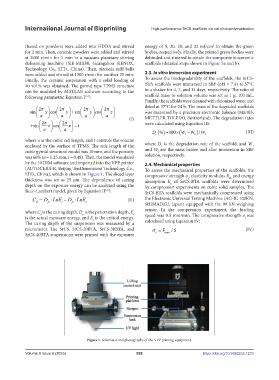
            by the 10 DIM software and imported into the VPP printer   2.4. Mechanical properties
            (AUTOCERA-R, Beijing TenDimensions Technology Co.,   To assess the mechanical properties of the scaffolds, the
            LTD., China), which is shown in Figure 1. The sliced layer   compressive strength σ , elasticity modulus E  and energy
            thickness was set as 25 μm. The dependence of curing   absorption  E  of SrCS-BTA scaffolds were determined
                                                                                                   m,
                                                                                 c
            depth on the exposure energy can be analyzed using the   by compression experiments on cubic solid samples. The
                                                                          a
            Beer–Lambert model, given by Equation II :         SrCS-BTA scaffolds were mechanically compressed using
                                              [35]
               C   D Ln  E  D Ln  E                (II)    the Electronic Universal Testing Machine (AG-IC 100KN,
                                p
                     p
                           i
                                      c
                d
                                                               SHIMADZU, Japan) equipped with the 90 kN weighing
            where C is the curing depth, D  is the penetration depth, E   i  sensor. In the compression experiment, the loading
                  d
                                    p
            is the actual exposure energy, and E  is the critical energy.   speed was 0.5 mm/min. The compressive strength σ was
                                                                                                         c
                                         c
            The curing depth of the suspension was measured by a   calculated using Equation IV:
            micrometer. The SrCS, SrCS-20BTA, SrCS-30BTA, and       F    S /                            (IV)
            SrCS-40BTA suspensions were printed with the exposure   c  max


                                      Figure 1. Schematic and photography of the VPP printing equipment.

            Volume 9 Issue 6 (2023)                        526                          https://doi.org/10.36922/ijb.1233

