


Page 537 - IJB-9-6
P. 537
International Journal of Bioprinting                  High-performance SrCS scaffolds via vat photopolymerization


                   Table 1. Curing parameter of SrCS-BTA composites
                    Component              Exposure energy (mJ/cm )        Curing depth (μm)
                                                           2
                    SrCS                   9                               73.53
                    SrCS-20BTA             20                              73.5
                    SrCS-30BTA             28                              73.52
                    SrCS-40BTA             32                              72.74

            to the stretching vibration of the unsaturated C=C bond of   shrinkage curves of the scaffold were obtained (Figure 5c
            HDDA, which decayed substantially in the printed green   and d), X/Y is the line contraction of length and width, and
            body, indicating the complete reaction of HDDA in VPP.   Z is the line contraction of height.
            The printed green body showed well-connected internal   In order to investigate the process of sintering
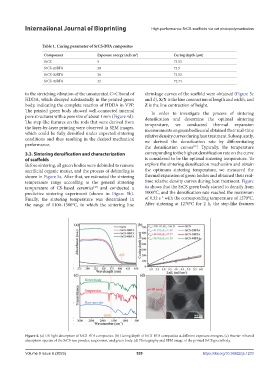
            pore structures with a pore size of about 1 mm (Figure 4d).   densification and determine the optimal sintering
            The step-like features on the rods that were derived from   temperature,  we  conducted  thermal  expansion
            the layer-by-layer printing were observed in SEM images,   measurements on green bodies and obtained their real-time
            which could be fully densified under expected sintering   relative density curves during heat treatment. Subsequently,
            conditions and thus resulting in the desired mechanical   we derived the densification rate by differentiating
            performance.                                       the densification curves . Typically, the temperature
                                                                                   [49]
            3.3. Sintering densification and characterization    corresponding to the highest densification rate on the curve
            of scaffolds                                       is considered to be the optimal sintering temperature. To
            Before sintering, all green bodies were debinded to remove   explore the sintering densification mechanism and obtain
            sacrificial organic matter, and the process of debinding is   the optimum sintering temperature, we measured the
            shown in Figure 5a. After that, we estimated the sintering   thermal expansion of green bodies and obtained their real-
            temperature range according to the general sintering   time relative density curves during heat treatment. Figure
                                         [48]
            temperature of CS-based ceramics  and conducted a   6a shows that the SrCS green body started to densify from
            predictive sintering experiment (shown in  Figure 5b).   1000°C, and the densification rate reached the maximum
                                                                      −1
            Finally,  the  sintering temperature  was determined  in   of 0.32 s  with the corresponding temperature of 1270°C.
            the range of 1100–1300°C, in which the sintering line   After sintering at 1270°C for  2 h, the step-like features


            Figure 4. (a) UV light absorption of SrCS-BTA composites. (b) Curing depth of SrCS-BTA composites at different exposure energies. (c) Fourier infrared
            absorption spectra of the SrCS raw powder, suspension, and green body. (d) Photography and SEM image of the printed SrCS green body.

            Volume 9 Issue 6 (2023)                        529                          https://doi.org/10.36922/ijb.1233

