


Page 538 - IJB-9-6
P. 538
International Journal of Bioprinting                  High-performance SrCS scaffolds via vat photopolymerization


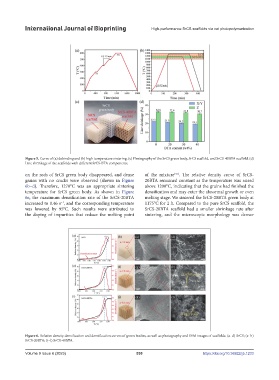
            Figure 5. Curve of (a) debinding and (b) high-temperature sintering. (c) Photography of the SrCS green body, SrCS scaffold, and SrCS-40BTA scaffold. (d)
            Line shrinkage of the scaffolds with different SrCS-BTA components.

                                                                           [50]
            on the rods of SrCS green body disappeared, and dense   of the mixture . The relative density curve of SrCS-
            grains with no cracks were observed (shown in  Figure   20BTA remained constant as the temperature was raised
            6b–d).  Therefore,  1270°C  was an  appropriate sintering   above 1200°C, indicating that the grains had finished the
            temperature for SrCS green body. As shown in  Figure   densification and may enter the abnormal growth or even
            6e, the maximum densification rate of the SrCS-20BTA   melting stage. We sintered the SrCS-20BTA green body at
            increased to 0.46 s , and the corresponding temperature   1175°C for 2 h. Compared to the pure SrCS scaffold, the
                           −1
            was lowered by 95°C. Such results were attributed to   SrCS-20BTA  scaffold  had  a  smaller  shrinkage  rate  after
            the doping of impurities that reduce the melting point   sintering, and the microscopic morphology was denser


            Figure 6. Relative density densification and densification curves of green bodies, as well as photography and SEM images of scaffolds. (a–d) SrCS; (e–h)
            SrCS-20BTA; (i–l) SrCS-40BTA.

            Volume 9 Issue 6 (2023)                        530                          https://doi.org/10.36922/ijb.1233

