


Page 540 - IJB-9-6
P. 540
International Journal of Bioprinting                  High-performance SrCS scaffolds via vat photopolymerization


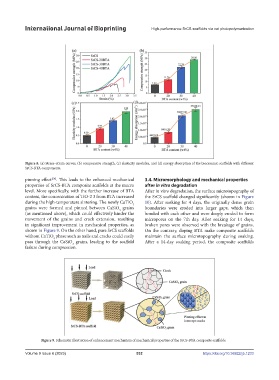
            Figure 8. (a) Stress–strain curves, (b) compressive strength, (c) elasticity modulus, and (d) energy absorption of the bioceramic scaffolds with different
            SrCS-BTA components.

            pinning effect . This leads to the enhanced mechanical   3.4. Micromorphology and mechanical properties
                       [54]
            properties of SrCS-BTA composite scaffolds at the macro   after in vitro degradation
            level. More specifically, with the further increase of BTA   After in vitro degradation, the surface microtopography of
            content, the concentration of TiO-2 3 from BTA increased   the SrCS scaffold changed significantly (shown in Figure
            during the high-temperature sintering. The newly CaTiO 3   10). After soaking for 4 days, the originally dense grain
            grains  were  formed  and  pinned  between  CaSiO   grains   boundaries were eroded into larger gaps, which then
                                                    3
            (as mentioned above), which could effectively hinder the   bonded with each other and were deeply eroded to form
            movement of the grains and crack extension, resulting   micropores on the 7th day. After soaking for 14 days,
            in significant improvement in mechanical properties, as   broken pores were observed with the breakage of grains.
            shown in Figure 9. On the other hand, pure SrCS scaffolds   On the contrary, doping BTA make composite scaffolds
            without CaTiO  phase such as nails and cracks could easily   maintain the surface microtopography during soaking.
                        3
            pass through the CaSiO  grains, leading to the scaffold   After a 14-day soaking period, the composite scaffolds
                                3
            failure during compression.


                   Figure 9. Schematic illustration of enhancement mechanism of mechanical properties of the SrCS-BTA composite scaffolds.

            Volume 9 Issue 6 (2023)                        532                          https://doi.org/10.36922/ijb.1233

