


Page 543 - IJB-9-6
P. 543
International Journal of Bioprinting                  High-performance SrCS scaffolds via vat photopolymerization


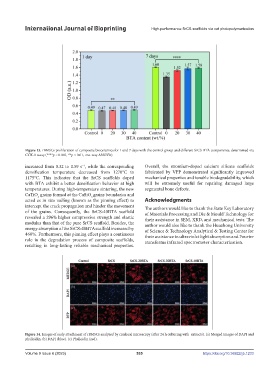
            Figure 13. rBMSCs proliferation of composite bioceramics for 1 and 7 days with the control group and different SrCS-BTA components, determined via
            CCK-8 assay (****p < 0.001, **p < 0.01, one-way ANOVA).

            increased  from  0.32 to 0.59 s , while the  corresponding   Overall,  the  strontium-doped  calcium  silicate  scaffolds
                                    −1
            densification  temperature  decreased  from  1270°C to   fabricated  by  VPP  demonstrated  significantly  improved
            1175°C.  This  indicates  that  the  SrCS  scaffolds  doped   mechanical properties and tunable biodegradability, which
            with BTA exhibit a better densification behavior at high   will  be  extremely  useful  for  repairing  damaged  large
            temperatures. During high-temperature sintering, the new   segmental bone defects.
            CaTiO  grains formed at the CaSiO grains boundaries and
                                        3
                 3
            acted as in situ nailing (known as the pinning effect) to   Acknowledgments
            intercept the crack propagation and hinder the movement   The authors would like to thank the State Key Laboratory
            of the grains.  Consequently,  the  SrCS-40BTA  scaffold   of Materials Processing and Die & Mould Technology for
            revealed a 296% higher compressive strength and elastic   their assistance in SEM, XRD, and mechanical tests. The
            modulus than that of the pure SrCS scaffold. Besides, the   author would also like to thank the Huazhong University
            energy absorption of the SrCS-40BTA scaffold increased by   of Science & Technology Analytical & Testing Center for
            460%. Furthermore, this pinning effect plays a continuous   their assistance in ultraviolet light absorption and Fourier
            role  in  the  degradation  process  of  composite  scaffolds,   transforms infrared spectrometer characterization.
            resulting  in  long-lasting  reliable  mechanical  properties.


            Figure 14. Images of early attachment of rBMSCs analyzed by confocal microscopy (after 24 h culturing with  extracts). (a) Merged images of DAPI and
            phalloidin. (b) DAPI (blue). (c) Phalloidin (red).


            Volume 9 Issue 6 (2023)                        535                          https://doi.org/10.36922/ijb.1233

