


Page 539 - IJB-9-6
P. 539
International Journal of Bioprinting                  High-performance SrCS scaffolds via vat photopolymerization


            (shown in Figure 6f–h). With increasing BTA content to   Figure 8a shows the stress–strain behaviors of the
            40 wt.% (SrCS-40BTA), the maximum densification rate   prepared SrCS scaffolds. The stress–strain curves revealed
            further increased to 0.59 s , while the corresponding   that the SrCS scaffolds possessed two stages of elastic
                                   −1
            temperature was kept at 1176°C (Figure 6i). After sintering   deformation and brittle fracture. With the increase
            at 1175°C for 2 h, the shrinkage rate of the SrCS-40BTA   of strain, brittle fractures occurred in the thin bars of
            scaffold was further reduced (shown                scaffolds, and the stress value fluctuated up and down
               in Figure 6j–l).                                during compression, resulting in a zigzag curve. When the
                                                               scaffolds were completely broken, the compressive strength
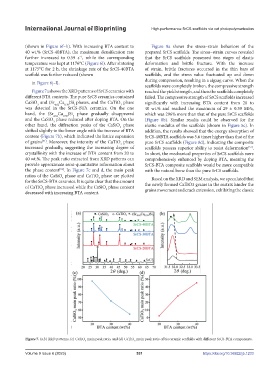
               Figure 7a shows the XRD patterns of SrCS ceramics with   reached the yield strength, and then the scaffolds completely
            different BTA contents. The pure SrCS ceramics contained   failed. The compressive strength of SrCS scaffolds increased
            CaSiO  and (Sr Ca )Si phases, and the CaTiO  phase   significantly with increasing BTA content from 20 to
                            0.38
                        4.62
                                 3
                 3
                                                    3
            was detected in the SrCS-BTA ceramics. On the one   40 wt.% and reached the maximum of 29 ± 0.39 MPa,
            hand, the (Sr Ca )Si  phase gradually disappeared   which was 296% more than that of the pure SrCS scaffolds
                                3
                        4.62
                            0.38
            and the CaSiO  phase reduced after doping BTA. On the   (Figure 8b). Similar results could be observed for the
                        3
            other hand, the diffraction peaks of the CaSiO  phase   elastic modulus of the scaffolds (shown in Figure 8c). In
                                                    3
            shifted slightly to the lower angle with the increase of BTA   addition, the results showed that the energy absorption of
            content (Figure 7b), which indicated the lattice expansion   SrCS-40BTA scaffolds was 5.6 times higher than that of the
            of grains . Moreover, the intensity of the CaTiO  phase   pure SrCS scaffolds (Figure 8d), indicating the composite
                   [51]
                                                    3
            increased gradually, suggesting the increasing degree of   scaffolds possess superior ability to resist deformation .
                                                                                                           [53]
            crystallinity with the increase of BTA content from 20 to   In short, the mechanical properties of SrCS scaffolds were
            40 wt.%. The peak ratio extracted from XRD patterns can   comprehensively enhanced by doping BTA, meaning the
            provide approximate semi-quantitative information about   SrCS-BTA composite scaffolds would be more compatible
            the phase content . In Figure 7c and d, the main peak   with the natural bone than the pure SrCS scaffolds.
                          [52]
            ratios of the CaSiO  phase and CaTiO  phase are plotted   Based on the XRD and SEM analysis, we speculated that
                            3
                                           3
            for the SrCS-BTA ceramics. It is quite clear that the amount   the newly formed CaTiO3 grains in the matrix hinder the
            of CaTiO  phase increased while the CaSiO  phase content   grains movement and crack extension, exhibiting the classic
                   3
                                              3
            decreased with increasing BTA content.


            Figure 7. (a,b) XRD patterns, (c) CaSiO  main peak ratio, and (d) CaTiO  main peak ratio of bioceramic scaffolds with different SrCS-BTA components.
                                     3                    3

            Volume 9 Issue 6 (2023)                        531                          https://doi.org/10.36922/ijb.1233

