


Page 542 - IJB-9-6
P. 542
International Journal of Bioprinting                  High-performance SrCS scaffolds via vat photopolymerization


                   Figure 11. (a) Degradation ratio and (b) compressive strength of bioceramic scaffolds with different SrCS-BTA components after
                   soaking for 0–14 days.

            composite scaffold group was similar to the control group.   that SrCS-BTA composite scaffolds exhibited excellent
            Overall, it is  proved that the  composite  scaffold has no   biocompatibility.
            cytotoxicity and good biocompatibility.
               The rBMSCs were seeded on the surface of composite   4. Conclusion
            bioceramic  wafers  to  evaluate  their  biocompatibility   In this study, we fabricated  biomimetic  SrCS  scaffolds
            (shown in Figure 14). After culturing for 24 h, the rBMSCs   with highly enhanced mechanical properties and tunable
            were  evenly  distributed  and  stretched  on  the  surface   biodegradability  using  BTA  as  a  dopant.  SrCS-BTA
            of the wafer. As a result, the composite bioceramics   scaffolds  with  complex-shaped  biomimetic  TPMS
            provided a conducive surface microenvironment for the   structures and a high porosity of 66% were fabricated by
            initial adhesion of cells. Therefore, it could be concluded   the VPP technique. When the BTA content increased from
                                                               0 to 40 wt.%, the maximum densification rate of scaffolds


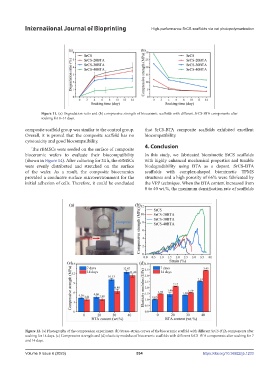
            Figure 12. (a) Photography of the compression experiment. (b) Stress–strain curves of the bioceramic scaffold with different SrCS-BTA components after
            soaking for 14 days. (c) Compressive strength and (d) elasticity modulus of bioceramic scaffolds with different SrCS-BTA components after soaking for 7
            and 14 days.

            Volume 9 Issue 6 (2023)                        534                          https://doi.org/10.36922/ijb.1233

