


Page 157 - IJOCTA-15-1
P. 157
Modeling the renewable energy development in T¨urkiye with optimization
                                                              by the optimum solution:
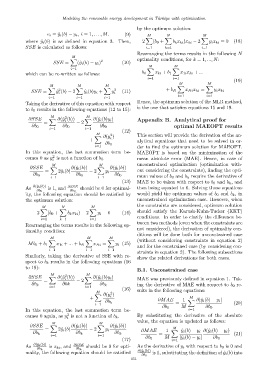
                      e i = ˆy i (b) − y i , i = 1, . . . , M.  (9)  M     N               M
                                                                  X       X               X
            where ˆy i (b) is as defined in equation 3. Then,   2    (b 0 +   b k x ki )x ki − 2  y i x ki = 0  (18)
            SSE is calculated as follows:                         i=1     k=1              i=1
                                                              Rearranging the terms results in the following N
                                 M
                                X             2               optimality conditions, for k = 1, ..., N:
                         SSE =     (ˆy i (b) − y i )   (10)
                                                                   M          M
                                i=1                               X           X
            which can be re-written as follows:                 b 0   x ki + b 1  x 1i x ki + ...
                                                                   i=1        i=1
                                                                                                         (19)
                                                                                 M           M
                       M           M            M                               X            X
                      X    2       X           X    2                              x Ni x ki =
               SSE =      ˆ y (b) − 2  ˆ y i (b)y i +  y i  (11)           + b N                y i x ki
                           i
                                                                                i=1          i=1
                       i=1         i=1         i=1
            Taking the derivative of this equation with respect  Hence, the optimum solution of the MLR method,
            to b 0 results in the following equations (12 to 15):  is the one that satisfies equations 15 and 19.
                       M      2        M
              ∂SSE     X   ∂(ˆy (b))   X  ∂(ˆy i (b)y i )     Appendix B. Analytical proof for
                              i
                    =              − 2
               ∂b 0          ∂b 0            ∂b 0                             optimal MAEOPT results
                       i=1             i=1
                                                       (12)
                                            M     2
                                           X   ∂(y )          This section will provide the derivation of the an-
                                                  i
                                         +                    alytical equations that need to be solved in or-
                                                ∂b 0
                                           i=1                der to find the optimum solution for MAEOPT.
            In this equation, the last summation term be-     MAEOPT is based on the minimization of the
                        2
            comes 0 as y is not a function of b 0 .           mean absolute error (MAE). Hence, in case of
                        i
                        M                    M                unconstrained optimization (optimization with-
              ∂SSE     X         ∂(ˆy i (b))  X   ∂(ˆy i (b))
                     =     2ˆy i (b)     − 2    y i           out considering the constraints), finding the opti-
                ∂b 0               ∂b 0             ∂b 0
                        i=1                  i=1              mum values of b 0 and b k require the derivative of
                                                       (13)   MAE to be taken with respect to b 0 and b k , and
                ∂(ˆy i (b))    ∂SSE
            As        is 1, and      should be 0 for optimal-  then being equated to 0. Solving those equations
                 ∂b 0           ∂b 0
            ity, the following equation should be satisfied by  would yield the optimum values of b 0 and b k , in
            the optimum solution:                             unconstrained optimization case. However, when
                                                              the constraints are considered, optimum solution
                    M       N            M
                   X        X            X                    should satisfy the Karush-Kuhn-Tucker (KKT)
                  2   (b 0 +   b k x ki ) − 2  y i = 0  (14)
                                                              conditions. In order to clarify the difference be-
                   i=1      k=1          i=1
                                                              tween two methods (even when the constraints are
            Rearranging the terms results in the following op-
            timality condition:                               not considered), the derivation of optimality con-
                                                              ditions will be done both for unconstrained case
                       M                M         M
                       X               X         X            (without considering constraints in equation 2)
             Mb 0 + b 1   x 1i + ... + b N  x Ni =  y i (15)
                                                              and for the constrained case (by considering con-
                       i=1             i=1       i=1
                                                              straints in equation 2). The following subsections
            Similarly, taking the derivative of SSE with re-  show the related derivations for both cases.
            spect to b k results in the following equations (16
            to 19):
                                                              B.1. Unconstrained case
                       M      2        M
              ∂SSE     X   ∂(ˆy (b))   X  ∂(ˆy i (b)y i )     MAE was previously defined in equation 1. Tak-
                              i
                    =              − 2
               ∂b k          ∂bk             ∂b k             ing the derivative of MAE with respect to b 0 re-
                       i=1             i=1
                                                       (16)
                                            M                 sults in the following equations:
                                                  2
                                           X   ∂(y )
                                                                                     M
                                         +        i                    ∂MAE       1  X  ∂|ˆy i (b) − y i |
                                                ∂b k
                                           i=1                                 =                         (20)
                                                                         ∂b 0     M         ∂b 0
            In this equation, the last summation term be-                            i=1
                               2
            comes 0 again, as y is not a function of b k .    By substituting the derivative of the absolute
                               i
                                                              value, the equation is updated as follows:
                        M                    M
              ∂SSE     X         ∂(ˆy i (b))  X   ∂(ˆy i (b))
                                                                              M
                     =     2ˆy i (b)     − 2    y i             ∂MAE       1  X   ˆ y i (b) − y i ∂(ˆy i (b) − y i )
                ∂b k               ∂b k             ∂b k                =                                (21)
                        i=1                  i=1                          M      |ˆy i (b) − y i |
                                                       (17)       ∂b 0       i=1                ∂b 0
                ∂(ˆy i (b))       ∂SSE
            As         is x ki , and   should be 0 for opti-  As the derivative of y i with respect to b 0 is 0 and
                 ∂b k              ∂b k                       ∂(ˆy i (b))
            mality, the following equation should be satisfied       is 1, substituting the definition of ˆy i (b) into
                                                                ∂b 0
                                                           151

