


Page 182 - IJOCTA-15-1
P. 182
Y. Olmez et al. / IJOCTA, Vol.15, No.1, pp.166-182 (2025)


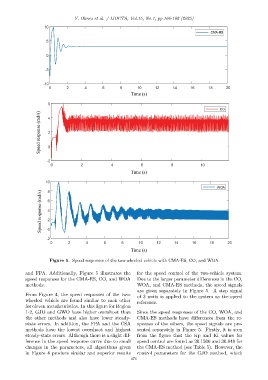
                       Figure 5. Speed responses of the two-wheeled vehicle with CMA-ES, CO, and WOA

            and FPA. Additionally, Figure 5 illustrates the   for the speed control of the two-vehicle system.
            speed responses for the CMA-ES, CO, and WOA       Due to the larger parameter differences in the CO,
            methods.                                          WOA, and CMA-ES methods, the speed signals
                                                              are given separately in Figure 5. A step signal
            From Figure 4, the speed responses of the two-
                                                              of 3 units is applied to the system as the speed
            wheeled vehicle are found similar to each other
                                                              reference.
            for eleven metaheuristics. In this figure for Region
            1-2, GJO and GWO have higher overshoot than       Since the speed responses of the CO, WOA, and
            the other methods and also have lower steady-     CMA-ES methods have differences from the re-
            state errors. In addition, the FPA and the CSA    sponses of the others, the speed signals are pre-
            methods have the lowest overshoot and highest     sented separately in Figure 5. Firstly, it is seen
            steady-state errors. Although there is a slight dif-  from the figure that the Kp and Ki values for
            ference in the speed response curve due to small  speed control are found as 20.1506 and 30.848 for
            changes in the parameters, all algorithms given   the CMA-ES method (see Table 5). However, the
            in Figure 4 produce similar and superior results  control parameters for the GJO method, which
                                                           176

