


Page 177 - IJOCTA-15-1
P. 177
Recent metaheuristics on control parameter determination
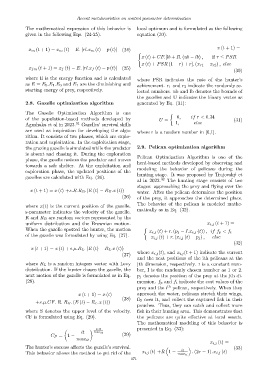
            The mathematical expression of this behavior is   local optimum and is formulated as the following
            given in the following Eqs. (24-25).              equation (30).


                                                                                                  x (t + 1) =
              x m (t + 1) = x m (t) − E. |rl.x m (t) − p (t)| (24)
                                                              (
                                                                x (t) + CF.[lb + R. (ub − lb) ,  if r ≤ PSR
                                                                x (t) + PSR (1 − r) + r]. (x r1 − x r2 ) , else
              x fm (t + 1) = x f (t) − E. |rl.x f (t) − p (t)|  (25)
                                                                                                         (30)
            where E is the energy function and is calculated  where PSR indicates the rate of the hunter’s
            as E = E 0 .E 1 .E 0 and E 1 are the diminishing and  achievement. r 1 and r 2 indicate the randomly se-
            starting energy of prey, respectively.            lected numbers. ub and lb denotes the bounds of
                                                              the gazelles and U indicates the binary vector as
            2.8. Gazelle optimization algorithm               generated by Eq. (31):

            The Gazelle Optimization Algorithm is one
                                                                                0,    if r < 0.34
            of the population-based methods developed by                U =                              (31)
            Agushaka et al in 2023. 31  Gazelles’ survival skills              1,      else
            are used as inspiration for developing the algo-  where r is a random number in [0,1].
            rithm. It consists of two phases, which are explo-
            ration and exploitation. In the exploitation stage,
            the grazing gazelle is simulated while the predator  2.9. Pelican optimization algorithm
            is absent and chasing it. During the exploration
                                                              Pelican Optimization Algorithm is one of the
            phase, the gazelle notices the predator and moves
                                                              herd-based methods developed by observing and
            towards a safe shelter. At the exploitation and
                                                              modeling the behavior of pelicans during the
            exploration phase, the updated positions of the
                                                              hunting stage. It was proposed by Trojovsk´y et
            gazelles are calculated with Eq. (26).                      32
                                                              al in 2022.  The hunting stage consists of two
                                                              stages: approaching the prey and flying over the
               x (t + 1) = x (t) +s.R.R B .(E (t) − R B .x (t))  water. After the pelican determines the position
                                                       (26)   of the prey, it approaches the determined place.
                                                              The behavior of the pelican is modeled mathe-
            where x(t) is the current position of the gazelle.
            s-parameter indicates the velocity of the gazelle.  matically as in Eq. (32).
            R and R B are random vectors represented by the
            uniform distribution and the Brownian motion.                                    x i,j (t + 1) =
            When the gazelle spotted the hunter, the motion
                                                                   x i,j (t) + r. (p j − I.x i,j (t)) , if f p < f i
            of the gazelle was formulated by using Eq. (27).
                                                                    x i,j (t) + r. (x i,j (t) − p j ) ,  else
                                                                                                         (32)
               x (t + 1) = x (t) +s.µ.R L . (E (t) − R L .x (t))
                                                              where x i,j (t), and x i,j (t + 1) indicate the current
                                                       (27)
                                                              and the next positions of the ith pelicans at the
            where R L is a random integers vector with Levy   jth dimension, respectively. r is a constant num-
            distribution. If the hunter chases the gazelle, the  ber, I is the randomly chosen number as 1 or 2.
            next motion of the gazelle is formulated as in Eq.  p j denotes the position of the prey at the jth di-
            (28).                                             mension. f p and f i indicate the cost values of the
                                                              prey and the i th  pelican, respectively. When they
                                    x (t + 1) = x (t)         approach the water, pelicans stretch their wings,
                                                       (28)   fly over it, and collect the captured fish in their
                 +s.µ.CF. R. R B . (E (t) − R L .x (t))
                                                              pouches. Thus, they can catch and collect more
            where S denotes the upper level of the velocity.  fish in their hunting area. This demonstrates that
            CF is formulated using Eq. (29).                  the pelicans are quite effective at local search.
                                                              The mathematical modeling of this behavior is
                                          2.it               presented in Eq. (33):

                                     it    max it
                        C F =  1 −                     (29)
                                   max it
                                                                                              x i,j (t) =
            The hunter’s success affects the gazelle’s survival.                 it                    (33)
            This behavior allows the method to get rid of the   x i,j (t) +R 1 −  max it  . (2r − 1) .x i,j (t)
                                                           171

