


Page 176 - IJOCTA-15-1
P. 176
Y. Olmez et al. / IJOCTA, Vol.15, No.1, pp.166-182 (2025)
            is the random nonlinear weight in the range of    where v i (t + 1) is the position value of the i th  rab-
            (0, ∞) and determined by the following equation   bit at (t + 1) th  iteration. x j (t) denotes the cur-
            (13):                                             rent solution of the j th  rabbit. n 1 and r 1 denote
                                      !
                              2.randn                   the parameter with normal distribution and the
                          it                        it
            w =     1 −                 . rand.               random parameter, respectively. The equations
                        max it                    max it
                                                              for the hiding stage are given in Eqs. (18-19):
                                                       (13)
                                                                  v i (t + 1) = x i (t) + R. (r 4 .g − x i (t))  (18)
            where randn denoted a random value in [(−1) −
            (+1)]. max it is the number of the maximum iter-
            ations.                                                      g (t) = x i (t) + H.g r .x i (t)  (19)

            2.5. Cheetah optimization algorithm               Where r4 and H represent the random and the
                                                              hiding parameters, respectively. g is the chosen
            Cheetah Optimizer is one of the methods inspired  burrow for hiding. Finally, an energy factor is
            by nature and was introduced by Akbari et al. in  modeled the provide balance between the explo-
            2022. 28  The algorithm is developed by taking in-  ration and the exploitation phases using Eq. (10).
            spiration from the behavior of the cheetahs during
            the hunting stage. According to hunting behav-
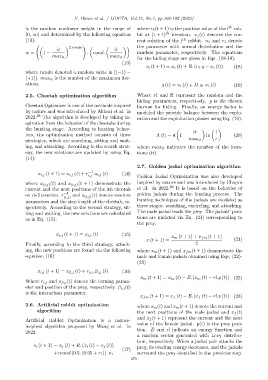
                                                                                       it        1
            iors, the optimization method consists of three           A (t) = 4 1 −          ln          (20)
            strategies, which are searching, sitting and wait-                       max it      r
            ing, and attacking. According to the search strat-  where max it indicates the number of the itera-
            egy, the new solutions are updated by using Eq.   tions (it).
            (14):

                                                              2.7. Golden jackal optimization algorithm
                  x i,j (t + 1) = x i,j (t) + r −1 .a i,j (t)  (14)  Golden Jackal Optimization was also developed
                                        i,j
            where x (i,j) (t) and x (i,j) (t + 1) demonstrate the  inspired by nature and was introduced by Chopra
            current and the next positions of the ith cheetah  et al. in 2022. 30  It is based on the behavior of
            on d-dimension. r −1  and a   (t) denote random   golden jackals during the hunting process. The
                             (i,j)     (i,j)
            parameters and the step length of the cheetah, re-  hunting techniques of the jackals are modeled as
            spectively. According to the second strategy, sit-  three stages: searching, encircling, and attacking.
            ting and waiting, the new solutions are calculated  The male jackal leads the prey. The jackals’ posi-
            as in Eq. (15):                                   tions are updated via Eq. (21) corresponding to
                                                              the prey.

                          x i,j (t + 1) = x i,j (t)    (15)                  x m (t + 1) + x fm (t + 1)
                                                                  x (t + 1) =                            (21)
            Finally, according to the third strategy, attack-                           2
            ing, the new positions are found via the following  where x m (t + 1) and x fm (t + 1) demonstrate the
            equation (16):                                    male and female jackals obtained using Eqs. (22)-
                                                              (23)
                  x i,j (t + 1) = x β,j (t) + r i,j .β i,j (t)  (16)
                                                               x m (t + 1) = x m (t) − E. |x m (t) − rl.p (t)| (22)
            Where r i,j and x β,j (t) denote the turning param-
            eter and position of the prey, respectively. β i,j (t)
            is the interaction parameter.
                                                               x fm (t + 1) = x f (t) − E. |x f (t) − rl.p (t)|  (23)
            2.6. Artificial rabbit optimization               where x m (t) and x m (t + 1) denote the current and
                 algorithm                                    the next positions of the male jackal and x f (t)
                                                              and x f (t + 1) represent the current and the next
            Artificial Rabbit Optimization is a nature-
                                                              value of the female jackal. p(t) is the prey posi-
            inspired algorithm proposed by Wang et al. in
                                                              tion. E and rl indicate an energy function and
            2022.
                                                              a random vector generated with Levy distribu-
                                                              tion, respectively. When a jackal pair attacks the
                v i (t + 1) = x j (t) + R. (x i (t) − x j (t))  prey, its evading energy decreases, and the jackals
                                                       (17)
                         +round (0.5. (0.05 + r 1 )) .n 1     surround the prey identified in the previous step.
                                                           170

