


Page 175 - IJOCTA-15-1
P. 175
Recent metaheuristics on control parameter determination
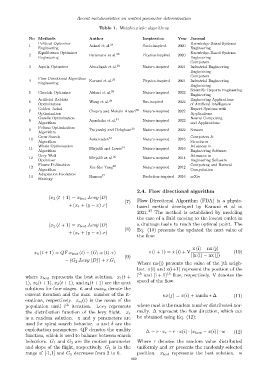
                                             Table 1. Metaheuristic algorithms

              No Methods                 Author                 Inspiration     Year Journal
                  Political Optimizer                                                 Knowledge-Based Systems
              1                          Askari et al. 24       Socio-inspired  2020
                  Engineering                                                         Engineering
                  Equilibrium Optimizer                                               Knowledge-Based Systems
              2                          Faramarzi et al. 25    Physics-inspired  2020
                  Engineering                                                         Engineering
                                                                                      Computers
              3   Aquila Optimizer       Abualigah et al. 26    Nature-inspired  2021  Industrial Engineering
                                                                                      Engineering
                                                                                      Computers
                  Flow Directional Algorithm
              4                          Karami et al. 27       Physics-inspired  2021  Industrial Engineering
                  Engineering
                                                                                      Engineering
                                                                                      Scientific Reports Engineering
              5   Cheetah Optimizer      Akbari et al. 28       Nature-inspired  2022
                                                                                      Engineering
                  Artificial Rabbits                                                  Engineering Applications
              6                          Wang et al. 29         Bio-inspired    2022
                  Optimization                                                        of Artificial Intelligence
                  Golden Jackal                              30                       Expert Systems with
              7                          Chopra and Mohsin Ansari  Nature-inspired  2022
                  Optimization                                                        Applications
                  Gazelle Optimization                                                Neural Computing
              8                          Agushaka et al. 31     Nature-inspired  2022
                  Algorithm                                                           and Applications
                  Pelican Optimization
              9                          Trojovsk´y and Dehghani 32  Nature-inspired  2022  Sensors
                  Algorithm
                  Crow Search                    33                                   Computers &
              10                         Askarzadeh             Nature-inspired  2016
                  Algorithm                                                           Structures
                  Whale Optimization                                                  Advances in
              11                         Mirjalili and Lewis 34  Nature-inspired  2016
                  Algorithm                                                           Engineering Software
                  Grey Wolf                                                           Advances in
              12                         Mirjalili et al. 35    Nature-inspired  2014
                  Optimizer                                                           Engineering Software
                  Flower Pollination               36                                 Computing and Natural
              13                         Xin-She Yang           Nature-inspired  2012
                  Algorithm                                                           Computation
                  Adaptation Evolution
              14                         Hansen 37              Evolution-inspired 2016  arXiv
                  Strategy
                                                              2.4. Flow directional algorithm
                       (x 2 (t + 1) = x best .Levy (D)
                                                        (7)   Flow Directional Algorithm (FDA) is a physic-
                               + (x r + (y − x) .r)           based method developed by Karami et al in
                                                              2021. 27  The method is established by modeling
                                                              the case of a fluid moving to the lowest outlet in
                       (x 2 (t + 1) = x best .Levy (D)        a drainage basin to reach the optimal point. The
                                                        (8)   Eq. (10) presents the updated the next value of
                               + (x r + (y − x) .r)
                                                              the flow:

                                                                                       x (i) − nx (j)
                x 4 (t + 1) = QF.x best (t) − (G 1 .x (t) .r)      x (i + 1) = x (i) + V                 (10)
                                                        (9)                           ||x (i) − nx (j)
                              − (G 2 .Levy (D)) + r.G 1
                                                              Where nx(j) presents the value of the jth neigh-
                                                              bor. x(i) and x(i+1) represent the position of the
                                                              i th  and (i + 1) th  flow, respectively. V denotes the
            where x best represents the best solution. x 1 (t +
                                                              speed of the flow.
            1), x 2 (t + 1), x 3 (t + 1), and x 4 (t + 1) are the next
            solutions for four stages. it and max it denote the
            current iteration and the max. number of the it-             nx(j) = x(i) + randn ∗ ∆        (11)
            erations, respectively. x m (t) is the mean of the
            population until t th  iteration. Levy represents  where rand is the random number distributed nor-
                                                              mally. ∆ represent the flow direction, which can
            the distribution function of the levy flight. x r
            is a random solution. x and y parameters are      be obtained using Eq. (12):
            used for spiral search behavior. a and δ are the
            exploitation parameters. QF denotes the quality
                                                                  ∆ = r · x r − r · x(i) · |x best − x(i)| · w  (12)
            function, which is used to balance between search
            behaviors. G 1 and G 2 are the motion parameter   Where r denotes the random value distributed
            and slope of the flight, respectively. G 1 is in the  uniformly and xr presents the randomly selected
            range of [-1,1] and G 2 decreases from 2 to 0.    position. x best represents the best solution. w
                                                           169

