


Page 118 - IJOCTA-15-2
P. 118
Parallel late acceptance hill-climbing for binary-encoded optimization problems
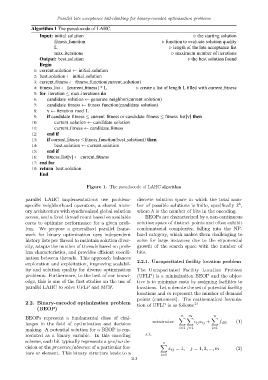
               Algorithm 1 The pseudocode of LAHC.
                   Input: initial solution                                             ▷ the starting solution
                         fitness function                                ▷ function to evaluate solution quality
                         L                                                  ▷ length of the late acceptance list
                         max iterations                                      ▷ maximum number of iterations
                   Output: best solution                                            ▷ the best solution found
                   Begin
                1: current solution ← initial solution
                2: best solution ← initial solution
                3: current fitness ← fitness function(current solution)
                4: fitness list ← [current fitness] * L       ▷ create a list of length L filled with current fitness
                5: for iteration ≤ max iterations do
                6:    candidate solution ← generate neighbor(current solution)
                7:    candidate fitness ← fitness function(candidate solution)
                8:    v ← iteration mod L
                9:    if candidate fitness ≤ current fitness or candidate fitness ≤ fitness list[v] then
               10:       current solution ← candidate solution
               11:       current fitness ← candidate fitness
               12:    end if
               13:    if current fitness ≤fitness function(best solution)) then
               14:       best solution ← current solution
               15:    end if
               16:    fitness list[v] ← current fitness
               17: end for
               18: return best solution
                   End


                                        Figure 1. The pseudocode of LAHC algorithm


            parallel LAHC implementations use problem-        discrete solution space in which the total num-
                                                                                                           h
            specific neighborhood operators, a shared mem-    ber of possible solutions is finite, specifically 2 ,
            ory architecture with synchronized global solution  where h is the number of bits in the encoding.
            access, and a fixed thread count based on available   BEOPs are characterized by a non-continuous
            cores to optimize performance for a given prob-   solution space of distinct points and often exhibit
            lem. We propose a generalized parallel frame-     combinatorial complexity, falling into the NP-
            work for binary optimization uses independent     hard category, which makes them challenging to
            history lists per thread to maintain solution diver-  solve for large instances due to the exponential
            sity, adapts the number of threads based on prob-  growth of the search space with the number of
            lem characteristics, and provides efficient coordi-  bits.
            nation between threads. This approach balances
                                                              2.2.1. Uncapacitated facility location problem
            exploration and exploitation, improving scalabil-
            ity and solution quality for diverse optimization  The Uncapacitated Facility Location Problem
            problems. Furthermore, to the best of our knowl-  (UFLP) is a minimization BEOP and the objec-
            edge, this is one of the first studies on the use of  tive is to minimize costs by assigning facilities to
            parallel LAHC to solve UFLP and MCP.              locations. Let n denote the set of potential facility
                                                              locations and m represent the number of demand
                                                              points (customers). The mathematical formula-
            2.2. Binary-encoded optimization problem        1                          21
                                                              tion of UFLP is as follows:
                 (BEOP)
                                                                                  n  m          n
            BEOPs represent a fundamental class of chal-                        X X            X
                                                                     minimize          c ij x ij +        (1)
            lenges in the field of optimization and decision                                      f i y i
            making. A potential solution for a BEOP is rep-                      i=1 j=1       i=1
            resented as a binary variable. In this encoding       s.t.
            scheme, each bit typically represents a yes/no de-           n
                                                                        X
            cision or the presence/absence of a particular fea-             x ij = 1,  j = 1, 2, ..., m   (2)
            ture or element. This binary structure leads to a
                                                                        i=1
                                                           313

