


Page 137 - IJOCTA-15-2
P. 137
E. Karabulut T¨urkseven, E. Gen¸c, and I. Safak / Vol.15, No.2, pp.330-342 (2025)

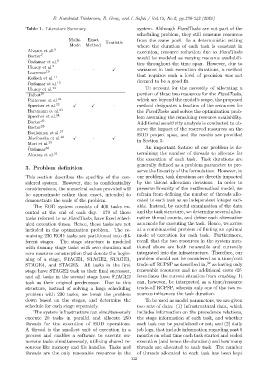
            Table 1. Literature Summary                       system. Although FixedTasks are not part of the
                                                              scheduling problem, they still consume resources
                                Multi-  Exact                 from the same pool. In a deterministic setting
                                                Heuristic
                                Mode   Method                 where the duration of each task is constant in
             Alvarez et al. 6                                 execution, resource reduction due to FixedTasks
             Boctor 7                                         would be modeled as varying resource availabili-
              ¨
             Ozdamar et al. 8                                 ties throughout the time span. However, due to
             Ulusoy et al. 9      ·       ·        ✓          variances in task execution durations, a method
             Lawrence 10                                      that requires such a level of precision was not
             Kolisch et al. 11
              ¨
             Ozdamar et al. 12                                deemed to be a good fit.
             Ulusoy et al. 13                                     To account for the necessity of allocating a
             Talbot 20                                        portion of these two resources for the FixedTasks,
             Patterson et al. 21                              which are beyond the model’s scope, the proposed
             Sprecher et al. 22   ✓       ✓        ·          method designates a fraction of the resources for
             Hartmann et al. 23                               the FixedTasks and solves the optimization prob-
             Sprecher et al. 24                               lem assuming the remaining resource availability.
             Boctor 25                                        Additional sensitivity analysis is conducted to ob-
             Boctor 26                                        serve the impact of the reserved resources on the
             Bouleimen et al. 27                              EOD project span, and the results are provided
             J´ozefowska et al. 28  ✓     ·        ✓          in Section 5.
             Mori et al. 29
              ¨
             Ozdamar 30                                           An important feature of our problem is de-
             Alcaraz et al. 31                                termining the number of threads to allocate for
                                                              the execution of each task. Task durations are
                                                              generally defined as a problem parameter to pre-
            3. Problem definition
                                                              serve the linearity of the formulation. However, in
            This section describes the specifics of the con-  our problem, task durations are directly impacted
            sidered system. However, due to confidentiality   by the thread allocation decisions. In order to
            considerations, the numerical values provided will  preserve linearity of the mathematical model, we
            be approximate rather than exact, intended to     refrain from defining the number of threads allo-
            demonstrate the scale of the problem.             cated to each task as an independent integer vari-
                The EOD system consists of 400 tasks ex-      able. Instead, by careful examination of the data
            ecuted at the end of each day.     170 of these   and the task structure, we determine several alter-
            tasks referred to as FixedTasks, have fixed sched-  native thread counts, and define each alternative
            uled execution times. Hence, these tasks are not  as a mode for executing the task. Hence, we arrive
            included in the optimization problem. The re-     at a combinatorial problem of finding an optimal
            maining 230 EOD tasks are partitioned into dif-   mode of execution for each task. Furthermore,
            ferent stages.  The stage structure is modeled    recall that the two resources in the system men-
            with dummy stage tasks with zero duration and     tioned above are both renewable and currently
            zero resource consumption that denote the begin-  integrated into the infrastructure. Therefore, our
            ning of a stage, STAGE1, STAGE2, STAGE3,          problem should not be considered as a time/cost
            STAGE4, and STAGE5. All tasks in the first        trade-off RCPSP as described in, 32  as having only
            stage have STAGE2 task as their final successor,  renewable resources and no additional costs dif-
            and all tasks in the second stage have STAGE2     ferentiates the current situation from crashing. It
            task as their original predecessor. Due to this   can, however, be interpreted as a time/resource
            structure, instead of solving a large scheduling  trade-off RCPSP, wherein only one of the two re-
            problem with 230 tasks, we break the problem      sources influences the task duration.
            down based on the stages, and determine the           To be used as model parameters, we are given
            schedule for each stage separately.               two sets of data: (1) infrastructural data, which
                The system infrastructure can simultaneously  includes information on the precedence relations,
            execute 20 tasks in parallel and allocate 250     the stage information of each task, and whether
            threads for the execution of EOD operations.      each task can be parallelized or not; and (2) daily
            A thread is the smallest unit of execution in a   job logs, that include information regarding past 6
            process and enables a software to execute nu-     months on what time each task started and ended
            merous tasks simultaneously, utilizing shared re-  execution (and hence the duration) and how many
            sources like memory and file handles. Tasks and   threads are allocated to each task. The number
            threads are the only renewable resources in the   of threads allocated to each task has been kept
                                                           332

