


Page 142 - IJOCTA-15-2
P. 142
End of day process optimization
                  • Activity List indicates the precedence-       The earliest resource and precedence feasible
                    feasible order of tasks to be scheduled.  time for task 2 is S 2 = 0.

                  • Mode List indicates the mode in which the
                    tasks are executed. It is the equivalent of
                    z im variable defined in Section 4.1.
                For a solution represented by Activity List
            and Mode List, the corresponding objective func-
            tion value f(x), i.e. the makespan of the EOD
            process, is calculated using Serial Schedule Gen-
            eration Scheme (SGS). 14                                      Figure 9. Step 4 of SGS
                We will illustrate how this algorithm works
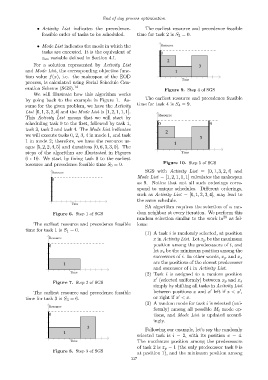
            by going back to the example in Figure 1. As-         The earliest resource and precedence feasible
            sume for the given problem, we have the Activity  time for task 4 is S 4 = 9.
            List [0, 1, 3, 2, 4] and the Mode List is [1, 2, 1, 1, 1].
            This Activity List means that we will start by
            scheduling task 0 to the first, followed by task 1,
            task 3, task 2 and task 4. The Mode List indicates
            we will execute tasks 0, 2, 3, 4 in mode 1, and task
            1 in mode 2; therefore, we have the resource us-
            ages [5, 2, 2, 4, 5] and durations [0, 6, 3, 3, 0]. The
            steps of the algorithm are illustrated in Figures
            6 - 10. We start by fixing task 0 to the earliest
            resource and precedence feasible time S 0 = 0.                Figure 10. Step 5 of SGS
                                                                  SGS with Activity List = [0, 1, 3, 2, 4] and
                                                              Mode List = [1, 2, 1, 1, 1] calculates the makespan
                                                              as 9. Notice that not all such orderings corre-
                                                              spond to unique schedules. Different orderings,
                                                              such as Activity List = [0, 1, 2, 3, 4], may lead to
                                                              the same schedule.
                                                                  SA algorithm requires the selection of a ran-
                         Figure 6. Step 1 of SGS              dom neighbor at every iteration. We perform this
                                                              random selection similar to the work in 28  as fol-
                The earliest resource and precedence feasible  lows:
            time for task 1 is S 1 = 0.
                                                                 (1) A task i is randomly selected, at position
                                                                     x in Activity List. Let x p be the maximum
                                                                     position among the predecessors of i, and
                                                                     let x s be the minimum position among the
                                                                     successors of i. In other words, x p and x s
                                                                     are the positions of the closest predecessor
                                                                     and successor of i in Activity List.
                                                                 (2) Task i is assigned to a random position
                                                                      ′
                                                                     x (selected uniformly) between x p and x s
                         Figure 7. Step 2 of SGS
                                                                     simply by shifting all tasks in Activity List
                                                                                               ′
                                                                                                            ′
                The earliest resource and precedence feasible        between positions x and x left if x < x ,
                                                                                ′
            time for task 3 is S 3 = 6.                              or right if x < x.
                                                                 (3) A random mode for task i is selected (uni-
                                                                     formly) among all possible M i mode op-
                                                                     tions, and Mode List is updated accord-
                                                                     ingly.
                                                                  Following our example, let’s say the randomly
                                                              selected task is i = 2, with its position x = 4.
                                                              The maximum position among the predecessors
                                                              of task 2 is x p = 1 (the only predecessor task 0 is
                         Figure 8. Step 3 of SGS
                                                              at position 1), and the minimum position among
                                                           337

