


Page 139 - IJOCTA-15-2
P. 139
E. Karabulut T¨urkseven, E. Gen¸c, and I. Safak / Vol.15, No.2, pp.330-342 (2025)
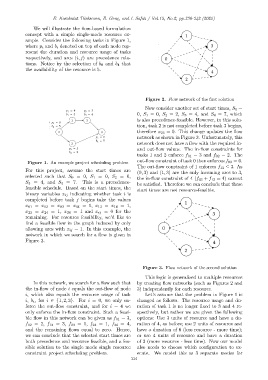
                We will illustrate the flow-based formulation
            concept with a simple single-mode resource ex-
            ample. Consider the following tasks in Figure 1,
            where p i and b i denoted on top of each node rep-
            resent the duration and resource usage of tasks
            respectively, and arcs (i, j) are precedence rela-
            tions. Notice by the selection of b 0 and b 4 that
            the availability of the resource is 5.


                                                                  Figure 2. Flow network of the first solution
                                                                  Now consider another set of start times, S 0 =
                                                              0, S 1 = 0, S 2 = 2, S 3 = 4, and S 4 = 7, which
                                                              is also precedence-feasible. However, in this solu-
                                                              tion, task 2 is not completed before task 3 begins,
                                                              therefore x 23 = 0. This change updates the flow
                                                              network as shown in Figure 3. Unfortunately, this
                                                              network does not have a flow with the required in-
                                                              and out-flow values. The in-flow constraints for
                                                              tasks 1 and 2 enforce f 01 = 3 and f 02 = 2. The
                                                              out-flow constraint of task 0 then enforces f 03 = 0.
             Figure 1. An example project scheduling problem
                                                              The out-flow constraint of 1 enforces f 13 ≤ 3. As
            For this project, assume the start times are
                                                              (0, 3) and (1, 3) are the only incoming arcs to 3,
            selected such that S 0 = 0, S 1 = 0, S 2 = 0,
                                                              the in-flow constraint of 4 (f 03 + f 13 = 4) cannot
            S 3 = 4, and S 4 = 7.     This is a precedence-
                                                              be satisfied. Therefore we can conclude that these
            feasible schedule. Based on the start times, the
                                                              start times are not resource-feasible.
            binary variables x ij indicating whether task i is
            completed before task j begins take the values
            x 01 = x 02 = x 03 = x 04 = 1, x 13 = x 14 = 1,
            x 23 = x 24 = 1, x 34 = 1 and x ij = 0 for the
            remaining. For resource feasibility, we’d like to
            find a feasible flow in the graph induced by only
            allowing arcs with x ij = 1. In this example, the
            network in which we search for a flow is given in
            Figure 2.


                                                                Figure 3. Flow network of the second solution
                                                                  This logic is generalized to multiple resources
                In this network, we search for a flow such that  by creating flow networks (such as Figures 2 and
            the in-flow of node i equals the out-flow of node  3) independently for each resource.
            i, which also equals the resource usage of task       Let’s assume that the problem in Figure 1 is
            i, b i , for i ∈ {1, 2, 3}. For i = 0, we only en-  changed as follows. The resource usage and du-
            force the out-flow constraint, and for i = 4 we   ration of task 1 is no longer fixed to 3 and 4 re-
            only enforce the in-flow constraint. Such a feasi-  spectively, but rather we are given the following
            ble flow in this network can be given as f 01 = 3,  options: Use 3 units of resource and have a du-
            f 02 = 2, f 13 = 3, f 23 = 1, f 24 = 1, f 34 = 4,  ration of 4, as before; use 2 units of resource and
            and the remaining flows equal to zero. Hence,     have a duration of 6 (less resource - more time);
            we can conclude that the selected start times are  or use 4 units of resource and have a duration
            both precedence and resource feasible, and a fea-  of 3 (more resource - less time). Now our model
            sible solution to the single mode single resource  also needs to choose which configuration to ex-
            constraint project scheduling problem.            ecute. We model this as 3 separate modes for
                                                           334

