


Page 144 - IJOCTA-15-2
P. 144
End of day process optimization
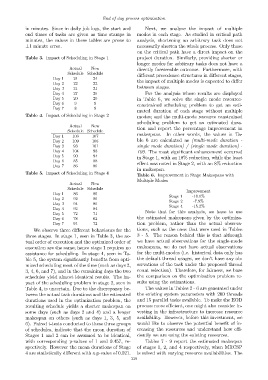
            in minutes. Since in daily job logs, the start and    Next, we analyze the impact of multiple
            end times of tasks are given as time stamps in    modes in each stage. As studied in critical path
            minutes, the values in these tables are prone to  analysis, shortening an arbitrary task does not
            ±1 minute error.                                  necessarily shorten the whole process. Only those
                                                              on the critical path have a direct impact on the
            Table 3. Impact of Scheduling in Stage 1          project duration. Similarly, providing shorter or
                                                              longer modes for arbitrary tasks does not have a
                                Actual    New                 directly foreseeable outcome. Furthermore, with
                               Schedule Schedule
                                                              different precedence structures in different stages,
                         Day 1    24      24
                         Day 2    22      22                  the impact of multiple modes is expected to differ
                         Day 3    21      21                  between stages.
                         Day 4    27      26                      For the analysis whose results are displayed
                         Day 5    20      20                  in Table 6, we solve the single mode resource-
                         Day 6    9        9                  constrained scheduling problem to get an esti-
                         Day 7    8        9
                                                              mated duration of each stage without multiple
            Table 4. Impact of Scheduling in Stage 2          modes; and the multi-mode resource constrained
                                                              scheduling problem to get an estimated dura-
                                Actual    New                 tion and report the percentage improvement in
                               Schedule Schedule
                         Day 1   103      107                 makespans. In other words, the values in Ta-
                         Day 2   109      106                 ble 6 are calculated as (multi-mode duration -
                         Day 3    93      101                 single mode duration) / (single mode duration) ·
                         Day 4   104      98                  100. The most significant enhancement occurred
                         Day 5    90      94                  in Stage 1, with an 18% reduction, while the least
                         Day 6    85      88
                         Day 7    86      86                  effect was noted in Stage 2, with an 8% reduction
                                                              in makespan.
            Table 5. Impact of Scheduling in Stage 4
                                                              Table 6. Improvement in Stage Makespans with
                                                              Multiple Modes
                                Actual    New
                               Schedule Schedule
                                                                                    Improvement
                         Day 1    86      86
                                                                            Stage 1   -18.1%
                         Day 2    92      86
                                                                            Stage 2    -7.9%
                         Day 3    94      86
                                                                            Stage 4   -15.2%
                         Day 4    92      84
                                                                  Note that for this analysis, we have to use
                         Day 5    72      71
                         Day 6    78      62                  the estimated makespans given by the optimiza-
                         Day 7    91      72                  tion problem, rather than the actual observa-
                We observe three different behaviours for the  tions, such as the ones that were used in Tables
            three stages. In stage 1, seen in Table 3, the ac-  3 - 5. The reason behind this is that although
            tual order of execution and the optimized order of  we have actual observations for the single-mode
            execution are the same; hence stage 1 requires no  makespans, we do not have actual observations
            assistance for scheduling. In stage 4, seen in Ta-  for the multi-modes (i.e. historical data only has
            ble 5, the system significantly benefits from opti-  the default thread usages, we don’t have any ob-
            mized scheduling most of the time (such as days 2,  servations of the task under the proposed thread
            3, 4, 6, and 7), and in the remaining days the two  count selection). Therefore, for fairness, we base
            schedules yield almost identical results. The im-  the comparison on the optimization problem re-
            pact of the scheduling problem in stage 2, seen in  sults using the estimations.
            Table 4, is uncertain. Due to the discrepancy be-     The values in Tables 2 - 6 are generated under
            tween the actual task durations and the estimated  the existing system parameters with 200 threads
            durations used in the optimization problem, the   and 15 parallel tasks available. To make the EOD
            resulting schedule yields a shorter makespan on   process more efficient, one might also consider in-
            some days (such as days 2 and 4) and a longer     vesting in the infrastructure to increase resource
            makespan on others (such as days 1, 3, 5, and     availability. However, before this investment, we
            6). Paired t-tests conducted to these three groups  would like to observe the potential benefit of in-
            of schedules, indicate that the mean duration of  creasing the resources and understand how effi-
            Stages 1 and 2 can be assumed to be identical,    ciently we are using the existing resources.
            with corresponding p-values of 1 and 0.457, re-       Tables 7 - 9 report the estimated makespan
            spectively. However the mean durations of Stage   of stages 1, 2, and 4 respectively, when MRCSP
            4 are statistically different with a p-value of 0.021.  is solved with varying resource availabilities. The
                                                           339

