


Page 145 - IJOCTA-15-2
P. 145
E. Karabulut T¨urkseven, E. Gen¸c, and I. Safak / Vol.15, No.2, pp.330-342 (2025)
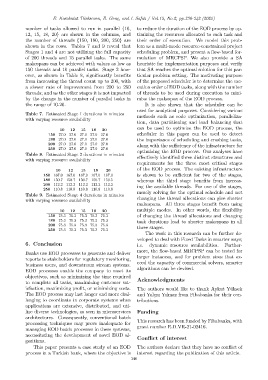
            number of tasks allowed to run in parallel {10,   to reduce the duration of the EOD process by op-
            12, 15, 18, 20} are shown in the columns, and     timizing the resources allocated to each task and
            the number of threads {150, 180, 200, 250} are    their order of execution. We model this prob-
            shown in the rows. Tables 7 and 9 reveal that     lem as a multi-mode resource-constrained project
            Stages 1 and 4 are not utilizing the full capacity  scheduling problem, and present a flow-based for-
            of 200 threads and 15 parallel tasks. The same    mulation of MRCPSP. We also provide a SA
            makespans can be achieved with values as low as   heuristic for implementation purposes and verify
            150 threads and 10 parallel tasks. Stage 2 how-   that SA reaches the optimal solution for this par-
            ever, as shown in Table 8, significantly benefits  ticular problem setting. The motivating purpose
            from increasing the thread count up to 200, with  of the proposed scheduler is to determine the exe-
            a slower rate of improvement from 200 to 250      cution order of EOD tasks, along with the number
            threads; and as the other stages it is not impacted  of threads to be used during execution to mini-
            by the change in the number of parallel tasks in  mize the makespan of the EOD process.
            the range of 10-20.                                   It is also shown that the scheduler can be
                                                              used for analytical purposes. Considering various
            Table 7. Estimated Stage 1 durations in minutes
                                                              methods such as code optimization, paralleliza-
            with varying resource availability
                                                              tion, data partitioning and load balancing that
                                                              can be used to optimize the EOD process, the
                            10  12   15   18  20
                      150 27.0 27.0 27.0 27.0 27.0            scheduler in this paper can be used to detect
                      180 27.0 27.0 27.0 27.0 27.0            the importance of scheduling and crashing tasks,
                      200 27.0 27.0 27.0 27.0 27.0            along with the sufficiency of the infrastructure for
                      250 27.0 27.0 27.0 27.0 27.0
                                                              optimizing the EOD process. Our analyses have
            Table 8. Estimated Stage 2 durations in minutes   effectively identified three distinct structures and
            with varying resource availability
                                                              requirements for the three most critical stages
                          10   12    15    18   20            of the EOD process. The existing infrastructure
                    150 167.0 167.0 167.0 167.0 167.0         is shown to be sufficient for two of the stages,
                    180 150.7 150.7 150.7 150.7 150.5         whereas the third stage benefits from increas-
                    200 112.2 112.2 112.2 112.2 112.2         ing the available threads. For one of the stages,
                    250 110.8 110.8 110.8 110.8 110.8
                                                              merely solving for the optimal schedule and not
            Table 9. Estimated Stage 4 durations in minutes
                                                              changing the thread allocations can give shorter
            with varying resource availability
                                                              makespans. All three stages benefit from using
                            10  12   15   18  20              multiple modes. In other words, the flexibility
                      150 75.3 75.3 75.3 75.3 75.3            of changing the thread allocations and changing
                      180 75.3 75.3 75.3 75.3 75.3            task durations lead to shorter makespans in all
                      200 75.3 75.3 75.3 75.3 75.3
                      250 75.3 75.3 75.3 75.3 75.3            three stages.
                                                                  The work in this research can be further de-
                                                              veloped to deal with Fixed Tasks in smarter ways;
            6. Conclusion                                     i.e.  dynamic resource availabilities.  Further-
                                                              more, the flow-based MRCPSP can be tested for
            Banks use EOD processes to generate and deliver
                                                              larger instances, and for problem sizes that ex-
            reports to stakeholders for regulatory monitoring,
                                                              ceed the capacity of commercial solvers, smarter
            business users, and downstream stream systems.
                                                              algorithms can be devised.
            EOD processes enable the company to meet its
            objectives, such as minimizing the time required
            to complete all tasks, maximizing customer sat-   Acknowledgments
            isfaction, maximizing profit, or minimizing costs.  The authors would like to thank Aykut Y¨uksek
            The EOD process may last longer and more chal-    and Yal¸cın Yılmaz from Fibabanka for their con-
            lenging to coordinate in corporate systems when   tributions.
            applications are extensive, distributed, and uti-
            lize diverse technologies, as seen in microservices  Funding
            architectures. Consequently, conventional batch
                                                              This research has been funded by Fibabanka, with
            processing techniques may prove inadequate for
                                                              grant number E.D.VR-21-02416.
            managing EOD batch processes in these systems,
            necessitating the development of novel EOD al-    Conflict of interest
            gorithms.
                This paper presents a case study of an EOD    The authors declare that they have no conflict of
            process in a Turkish bank, where the objective is  interest regarding the publication of this article.
                                                           340

