


Page 140 - IJOCTA-15-2
P. 140
End of day process optimization
            task 1. p 11 = 4 and b 111 = 3 denote the first   states that each task must be executed in exactly
            mode, p 12 = 6 and b 121 = 2 denote the second    one mode. (8) - (10) ensure y ijm = x ij ×z im . (11)
            mode, and p 13 = 3 and b 131 = 4 denote the third  ensures that if task i is completed before task j
            mode. To generalize our model to such settings,   begins, then the start time of task j should be at
            we utilize another set of binary variables z im to  least the start time of task i plus the duration of
            determine the active mode for each task and re-   task i. (12) and (13) are the node balance con-
            peat the same procedure of finding the flow with  straints for the flow of resources, indicating the
            the selected p im and b imr values.               flow of resource into and out of each task is equal
                A more formal description of the flow-based   to the resource requirement. Notice that the out-
            MRCPSP is formulated below, with the given as-    flow constraint (12) is not enforced for task n+1,
            sumptions and variable definitions:               and in-flow constraint (13) is not enforced for task
                                                              0. Finally, (14) ensures the resources flowing for-
                                                              ward, i.e., task i is allowed to pass on resources
             min S n+1                                  (2)   to task j only if task i is completed before task j
             s.t. S 0 = 0                               (3)   begins.
                                                                  In our case study, the number of tasks differ
                  x ij = 1          ∀ (i, j) ∈ E        (4)
                                                              for each stage subproblem. For all stage problems
                  x ij + x ji ≤ 1    ∀ i, j ∈ A         (5)   there are two renewable resources, R = 2, where
                  x ik ≥ x ij + x jk − 1  ∀ i, j, k ∈ A  (6)  the first resource corresponds to the threads, and
                                                              the second resource corresponds to the number of
                   M i
                   X                                          parallel tasks. Hence b im1 equals the thread al-
                      z im = 1      ∀ i ∈ A             (7)
                                                              locations of all tasks except 0 and n + 1 in each
                  m=1
                                                              mode, determined as discussed in Section 3; and
                  y ijm ≤ z im     ∀ i, j ∈ A ,         (8)
                                                              b im2 equals to 1 for all tasks except 0 and n + 1
                                    m = 1, . . . , M i
                                                              and for all modes. The values used in this study
                   M i                                        as big-M parameters in constraints (11) and (14)
                   X
                                                                                                    ˆ
                                                                          ˆ
                                                                   ˆ
                      y ijm = x ij  ∀ i, j ∈ A          (9)   are M ij = M for all i and j, where M equals
                  m=1                                         the sum of the longest task durations of each task
                  y ijm ≥ x ij + z im − 1  ∀ i, j ∈ A  (10)   (i.e.  P   max m p im ), as an upperbound on the
                                                                     i∈A
                                                                              ¯
                                                                                     ¯
                                                              makespan; and M ijr = M r for all i and j equals
                                    m = 1, . . . , M i
                                                              the total resource availability of resource r.
                             M i
                                           ˆ
                            X
                  S j − S i ≥   p im y ijm − M ij (1 − x ij )     It should also be noted that the proposed for-
                                                              mulation in (2) - (14) is also adaptable to settings
                            m=1
                                        ∀ i, j ∈ A     (11)   with fluctuating resource availabilities through
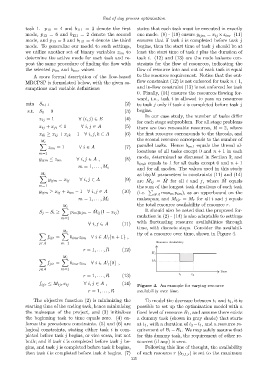
                                                              time, with discrete steps. Consider the availabil-
                             M i
                  X         X                                 ity of a resource over time, shown in Figure 4.
                      f ijr =   b imr z im  ∀ i ∈ A\{n + 1} ,
                  j∈A       m=1
                                      r = 1, . . . , R  (12)
                             M i
                  X         X
                      f jir =   b imr z im  ∀ i ∈ A\{0} ,
                  j∈A       m=1
                                      r = 1, . . . , R  (13)
                         ¯
                  f ijr ≤ M ijr x ij  ∀ i, j ∈ A ,     (14)
                                                              Figure 4. An example for varying resource
                                        r = 1, . . . , R      availability over time
                The objective function (2) is minimizing the      To model the decrease between t 1 and t 2 , it is
            starting time of the ending task, hence minimizing  possible to set up the optimization model with a
            the makespan of the project, and (3) initializes  fixed level of resource B 1 , and assume there exists
            the beginning task to time equals zero. (4) en-   a dummy task (shown in gray shade) that starts
            forces the precedence constraints. (5) and (6) are  at t 1 , with a duration of t 2 −t 1 , and a resource re-
            logical constraints, stating either task i is com-  quirement of B 1 −B 2 . We may safely assume that
            pleted before task j begins, or vice versa, but not  for this dummy task, the requirement of other re-
            both; and if task i is completed before task j be-  sources (if any) is zero.
            gins, and task j is completed before task k begins,   Following this line of thought, the availability
            then task i is completed before task k begins. (7)  of each resource r (b 0,1,r ) is set to the maximum
                                                           335

