


Page 90 - IJOCTA-15-2
P. 90
Comparison of fractional order sliding mode controllers on robot manipulator
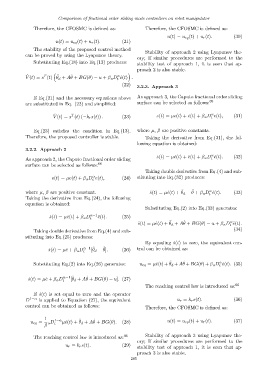
                Therefore, the CFOSMC is defined as:              Therefore, the CFOSMC is defined as:

                                                                           u(t) = u eq (t) + u r (t).    (30)
                          u(t) = u eq (t) + u r (t).   (21)
                The stability of the proposed control method      Stability of approach 2 using Lyapunov the-
            can be proved by using the Lyapunov theory.
                                                              ory; If similar procedures are performed to the
                Substituting Eq.(18) into Eq.(13) produces:   stability test of approach 1, it is seen that ap-
                                                              proach 2 is also stable.

             ˙
                                 ˙
                          ¨
                     T
                                                     α
            V (t) = s (t) θ d + Aθ + BG(θ) − u + β a D ˙e(t) .
                                                     t
                                                       (22)
                                                              3.2.3. Approach 3
                If Eq.(21) and the necessary equations above  As approach 3, the Caputo fractional order sliding
            are substituted in Eq. (22) and simplified:       surface can be selected as follows: 69
                                                                                               α
                         ˙
                                 T
                         V (t) = s (t) (−k r s(t)) .   (23)            s(t) = µe(t) + ˙e(t) + β a D e(t),  (31)
                                                                                               t
                Eq.(23) satisfies the condition in Eq.(13).   where µ, β are positive constants.
            Therefore, the proposed controller is stable.         Taking the derivative from Eq.(31), the fol-
                                                              lowing equation is obtained:
            3.2.2. Approach 2
                                                                                               α
                                                                       ˙ s(t) = µ˙e(t) + ¨e(t) + β a D ˙e(t).  (32)
            As approach 2, the Caputo fractional order sliding                                 t
            surface can be selected as follows: 68
                                                                  Taking double derivative from Eq.(4) and sub-
                                          α
                        s(t) = µe(t) + β a D e(t),     (24)   stituting into Eq.(32) produces:
                                          t
                                                                                      ¨
                                                                                  ¨
                                                                                              α
            where µ, β are positive constant.                       ˙ s(t) = µ˙e(t) + θ d − θ + β a D ˙e(t).  (33)
                                                                                              t
            Taking the derivative from Eq.(24), the following
            equation is obtained:
                                                                  Substituting Eq.(2) into Eq.(33) generates:
                       ˙ s(t) = µ˙e(t) + β a D α−1 ¨ e(t).  (25)
                                         t
                                                                                                       α
                                                                                   ˙
                                                                            ¨
                                                               ˙ s(t) = µ˙e(t) + θ d + Aθ + BG(θ) − u + β a D ˙e(t).
                                                                                                       t
                Taking double derivative from Eq.(4) and sub-                                            (34)
            stituting into Eq.(25) produces:
                                                                  By equaling ˙s(t) to zero, the equivalent con-
                       ˙ s(t) = µ˙e + β a D α−1 ¨  ¨   (26)   trol can be obtained as:
                                         [θ d − θ].
                                      t
                                                                            ¨
                                                                                   ˙
                                                                                                  α
                Substituting Eq.(2) into Eq.(26) generates:    u eq = µ˙e(t) + θ d + Aθ + BG(θ) + β a D ˙e(t). (35)
                                                                                                  t
              ˙ s(t) = µ˙e + β a D α−1 ¨  ˙
                                [θ d + Aθ + BG(θ) − u]. (27)
                             t
                                                                  The reaching control law is introduced as: 66
                If ˙s(t) is set equal to zero and the operator
            D 1−α  is applied to Equation (27), the equivalent                  u r = k r s(t).          (36)
            control can be obtained as follows:                   Therefore, the CFOSMC is defined as:


                     1
                                           ˙
                                    ¨
               u eq =  a D 1−α µ˙e(t) + θ d + Aθ + BG(θ).  (28)            u(t) = u eq (t) + u r (t).    (37)
                         t
                     β
                The reaching control law is introduced as: 66     Stability of approach 3 using Lyapunov the-
                                                              ory; If similar procedures are performed to the
                              u r = k r s(t).          (29)
                                                              stability test of approach 1, it is seen that ap-
                                                              proach 3 is also stable.
                                                           285

