


Page 88 - IJOCTA-15-2
P. 88
Comparison of fractional order sliding mode controllers on robot manipulator

            by 3 different sliding surfaces using the Caputo          ■ M(θ) =       M 11 M 12     is the inertia
            fractional operator. A simulation comparison be-                         M 21 M 22
            tween these 3 approaches and the classical SMC               matrix
            is performed and it is observed that approach 3
            gives better results than the classical SMC and   with
            other approaches in terms of overshoot, settling
                                                                          =     (M 1 + M 2 ) L 2  + M 2 L 2  +
            and error value for some derivative orders.           M 11                       1          2
                                                              2M 2 L 1 L 2 cos (θ 2 ),
                The rest of this paper is presented as follows:  M 12 = M 2 L + M 2 L 1 L 2 cos (θ 2 ),
                                                                         2
                                                                         2
            Section 2 describes the geometrical model of the  M 21 = M 12 ,
            2-DOF robot manipulator. Section 3 presents the   M 22 = M 2 L .
                                                                         2
                                                                         2
            classical SMC and fractional order sliding mode       ˙      ˙
            control designs. Section 4 shows the results and      θ 1 and θ 2 are the derivatives of the angular
            compares the three different approaches and clas-  position of the two joints representing the angu-
            sical SMC in MATLAB simulation and shows the      lar velocities.
            superiority of approach 3. Section 5 presents the  3. Controller design
            conclusions obtained from the study.
                                                              In order to use the equation of motion expressed
                                                              by Eq.(1) in the sliding mode control, it is neces-
                                                                               ¨
                                                              sary to leave the θ in the equation alone:
            2. Modeling of robot manipulator
            Shows a view of the robot manipulator with two    θ = −M  −1 (θ)C(θ, θ)θ − M −1 (θ)G(θ) + M −1 (θ)τ,
                                                                                ˙ ˙
                                                              ¨
            degrees of freedom in Figure 1.                                                               (2)
                                                                                         ˙
                                                              where, if A = M  −1 (θ)C(θ, θ), B = M −1 (θ) and
                                                              u = M −1 (θ)τ are written:


                                                                                  ˙
                                                                           ¨
                                                                          θ = −Aθ − BG(θ) + u.            (3)
                                                                  The main objective here is to design a control
                                                              law that enables tracking of the desired joint an-
                                                              gle θ d (t) and obtains an appropriate input torque
                                                              so that the tracking error converges to zero.
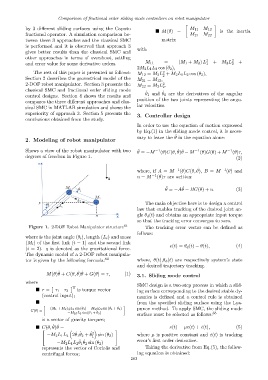
              Figure 1. 2-DOF Robot Manipulator structure 63      The tracking error vector can be defined as
                                                              follows:
            where is the joint angle (θ i ), length (L i ) and mass
            (M i ) of the first link (i = 1) and the second link
            (i = 2). g is denoted as the gravitational force.               e(t) = θ d (t) − θ(t),        (4)
            The dynamic model of a 2-DOF robot manipula-
            tor is given by the following formula: 64         where, θ(t),θ d (t) are respectively system’s state
                                                              and desired trajectory tracking.
                                    ˙ ˙
                           ¨
                      M(θ)θ + C(θ, θ)θ + G(θ) = τ,      (1)   3.1. Sliding mode control
            where
                                T                           SMC design is a two-step process in which a slid-
                 ■ τ =    τ 1 τ 2  is torque vector           ing surface corresponding to the desired stable dy-
                    (control input);                          namics is defined and a control rule is obtained
                 ■                                            from the specified sliding surface using the Lya-

                      − (M 1 + M 2 ) gL 1 sin (θ 1 ) − M 2 gL 2 sin (θ 1 + θ 2 )  punov method. To apply SMC, the sliding mode
               G(θ) =
                               −M 2 gL 2 sin (θ 1 + θ 2 )                                       65
                                                              surface must be selected as follows:
                    is a vector of gravity torques;
                         ˙ ˙
                 ■ C(θ, θ)θ =                                               s(t) = µe(t) + ˙e(t),         (5)
                    "                             #
                                   ˙ ˙
                      −M 2 L 1 L 2 2θ 1 θ 2 + θ ˙2  sin (θ 2 )  where µ is positive constant and ˙e(t) is tracking
                                          1
                                    ˙ ˙
                          −M 2 L 1 L 2 θ 1 θ 2 sin (θ 2 )     error’s first order derivative.
                    represents the vector of Coriolis and         Taking the derivative from Eq.(5), the follow-
                    centrifugal forces;                       ing equation is obtained:
                                                           283

