


Page 91 - IJOCTA-15-2
P. 91
¨
                          M. Yavuz, M. Ozt¨urk, B. Ya¸skıran / IJOCTA, Vol.15, No.2, pp.281-293 (2025)
            Table 1. 2-DOF robot manipulator parameters

                                                                                                          2
                      Mass,M (kg) Length(m) Initial position,θ Desired path,θ d Gravity,g (m/s )
              Link 1     M 1 = 1        L 1 = 1          θ 1 =  π         θ d1 = sin(t)          9.81
                                                              4
              Link 2     M 2 = 1        L 2 = 1          θ 2 =  π         θ d2 = sin(t)          9.81
                                                              2
            4. Results and discussion

            In this section, the performance of the classi-
            cal sliding mode controller and Caputo fractional
            order sliding mode controllers using 3 different
            sliding surface approaches are compared to each
            other. The simulation was carried out in MAT-
            LAB in the [0 3] time span. The trapezoid rule
            is used in simulations for numerical calculations
            because of its simplicity. Numerical step size is
            chosen as 10 −2 . The step size is chosen highly con-
            sidering the operating frequency of real systems.
            The CFOSMC controller parameters are chosen
            as k r = 10, µ = 1, β = 1 and α = 0.1, 0.5, 0.9.
            The robot parameters are given in Table (1).


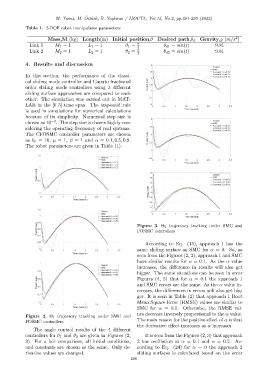
                                                              Figure 3. Θ 2 trajectory tracking under SMC and
                                                              FOSMC controllers

                                                                  According to Eq. (15), approach 1 has the
                                                              same sliding surface as SMC for α = 0. So, as
                                                              seen from the Figures (2, 3), approach 1 and SMC
                                                              have similar results for α = 0.1. As the α value
                                                              increases, the difference in results will also get
                                                              bigger. The same situations can be seen in error
                                                              Figures (4, 5) that for α = 0.1 the approach 1
                                                              and SMC errors are the same. As the α value in-
                                                              creases, the differences in errors will also get big-
                                                              ger. It is seen in Table (2) that approach 1 Root
                                                              Mean Square Error (RMSE) values are similar to
                                                              SMC for α = 0.1. Otherwise, the RMSE val-
                                                              ues decrease inversely proportional to the α value.
            Figure 2. Θ 1 trajectory tracking under SMC and
            FOSMC controllers                                 The main reason for the positive effect of α is that
                                                              the derivative effect increases as α increases.
                The angle control results of the 4 different
            controllers for θ 1 and θ 2 are given in Figures (2,  It is seen from the Figures (2, 3) that approach
            3). For a fair comparison, all initial conditions,  2 has oscillation at α = 0.1 and α = 0.5. Ac-
            and constants are chosen as the same. Only de-    cording to Eq. (24) for α = 0 the approach 2
            rivative values are changed.                      sliding surfaces is calculated based on the error
                                                           286

