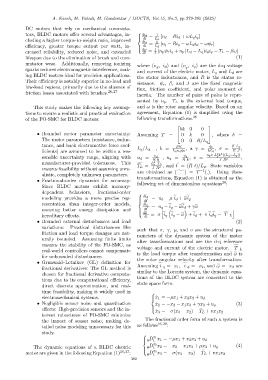
Page 10 - IJOCTA-15-3
P. 10

A. Kaveh, M. Vahedi, M. Gandomkar / IJOCTA, Vol.15, No.3, pp.379-395 (2025)
            DC motors that rely on mechanical commuta-
            tors, BLDC motors offer several advantages, in-     di d  =  1  [v d − Ri d + ωL q i q ]
                                                               dt    L d
                                                              
            cluding a higher torque-to-weight ratio, improved   di q  1
            efficiency, greater torque output per watt, in-      dt  =  L d  [v q − Ri q − ωL d i d − ωψ r ]
                                                              
                                                               dω    1
            creased reliability, reduced noise, and extended    dt  =  J  [n p ψ r i q + n p (L d − L q )i d i q − T L − βω]
            lifespan due to the elimination of brush and com-                                             (1)
            mutator wear. Additionally, removing ionizing
                                                              where (v , i d ) and (v , i q ) are the d-q voltage
                                                                                    q
                                                                       d
            sparks reduces electromagnetic interference, mak-
                                                              and current of the electric motor, L q and L d are
            ing BLDC motors ideal for precision applications.
                                                              the stator inductances, and R is the stator re-
            Their efficiency is notably superior in no-load and
                                                              sistance. ψ r , β, and J are the fixed magnetic
            low-load regions, primarily due to the absence of  flux, friction coefficient, and polar moment of
            friction losses associated with brushes. 26,27
                                                              inertia. The number of pairs of poles is repre-
                                                              sented by n p .  T L is the external load torque,
                This study makes the following key assump-    and ω is the rotor angular velocity. Based on an
            tions to ensure a realistic and practical evaluation  agreement, Equation (1) is simplified using the
            of the FO-SMC for BLDC motors:                    following transformations. 26
                                                                                             
                                                                                 bk 0     0
                  • Bounded motor parameter uncertainty:      Assuming T =        0  k   0    , where b =
                    The motor parameters (resistance, induc-                      0  0 R/L q
                    tance, and back electromotive force coef-                  βR             ψ r       β L q
                                                              L q /L d  , k =       , a γ =      , σ =      ,
                    ficients) are assumed to be within a rea-                 L q n q ψ r    kL q       R J
                                                                                                 2 2
                                                                                             n pb L q k ((L d −L q ))
                    sonable uncertainty range, aligning with  u d =  v d  , u q =  v q  , v =               ,
                                                                     R k          R k             J R 2
                                                                     2
                    manufacturer-provided tolerances.  This         L q T L     ′
                                                              T L =     2 , and t = (R t)/L q . State variables
                                                              f
                    ensures feasibility without assuming unre-       J R                  −1
                                                              are obtained as (g. ) = T     (.).  Using these
                    alistic, completely unknown parameters.
                                                              transformations, Equation (1) is obtained as the
                  • Fractional-order dynamics for accuracy:                                         26
                                                              following set of dimensionless equations :
                    Since BLDC motors exhibit memory-
                    dependent   behaviors,  fractional-order
                                                              
                    modeling provides a more precise rep-       d e i d ′ = u d − µ i d + eωi q
                                                                                    e
                                                                              e
                                                               dt
                                                              
                    resentation than integer-order models,      d e i q ′ = u q − i q − eωi d + γeω
                                                                                  e
                                                                            e
                    ensuring better energy dissipation and     dt       h                            i
                                                               deω
                                                              
                    hereditary effects.                          dt  = σ i q i q − eω + i d + v i d i q − T L
                                                                                       e
                                                                                                    f
                                                                          e e
                                                                                              e e
                  • Bounded external disturbances and load                                                (2)
                    variations:  Practical disturbances like
                                                              such that σ, γ, µ, and v are the structural pa-
                    friction and load torque changes are nat-
                                                              rameters of the dynamic system of the motor
                    urally bounded.  Assuming finite limits
                                                              after transformations and are the d-q reference
                    ensures the stability of the FO-SMC, as
                                                              voltage and current of the electric motor.  f
                                                                                                         T L
                    real-world controllers cannot compensate
                                                              is the load torque after transformation and eω is
                    for unbounded disturbances.
                                                              the rotor angular velocity after transformation.
                  • Grunwald–Letnikov (GL) definition for
                                                                                  f
                                                                       f
                    fractional derivatives: The GL method is  Assuming i q = x 1 , i d = x 2 , and eω = x 3 are
                                                              similar to the Lorentz system, the dynamic equa-
                    chosen for fractional derivative computa-
                                                              tions of the BLDC system are converted to the
                    tions due to its computational efficiency,
                                                              state space form:
                    direct discrete approximation, and real-
                    time feasibility, making it widely used in
                                                                    
                    electromechanical systems.                       ˙x 1 = −µx 1 + x 2 x 3 + u d
                                                                    
                  • Negligible sensor noise and quantization          ˙ x 2 = −x 2 − x 1 x 3 + γx 3 + u q  (3)
                    effects: High-precision sensors and the in-                          ˜
                                                                    
                                                                      ˙ x 3 = −σ(x 3 − x 2 ) − T L + vx 1 x 2
                    herent robustness of FO-SMC minimize
                    the impact of sensor noise, making de-        The fractional order form of such a system is
                                                                       16,28
                    tailed noise modeling unnecessary for this  as follows  :
                    study.
                                                                
                                                                     q 1
                                                                 D x 1 = −µx 1 + x 2 x 3 + u d
                                                                0   t
                                                                     q 2                                  (4)
                The dynamic equations of a BLDC electric          0 D x 2 = −x 2 − x 1 x 3 + µx 3 + u q
                                                                     t
                                                                    q 3                   ˜
                                                      26,27
            motor are given in the following Equation (1)  :     0 D x 3 = −σ(x 3 − x 2 ) − T L + vx 1 x 2
                                                                     t
                                                           382
   5   6   7   8   9   10   11   12   13   14   15