


Page 9 - IJOCTA-15-3
P. 9
Improving the performance of a chaotic nonlinear system of fractional-order...
            control. IT2 FLC introduces a footprint of un-    A suitable sliding surface is designed to stabilize
            certainty, enhancing adaptability to nonlineari-  the system, minimize oscillations, and improve
            ties and external disturbances compared to type-  adaptability under external disturbances and pa-
            1 FLC. 21  This method has demonstrated superior  rameter uncertainties. The results demonstrate
            performance in uncertain and nonlinear systems,   the superior performance of FO-SMC in mitigat-
            particularly in real-world BLDC motor applica-    ing chaos while ensuring system stability and ef-
            tions where parameter variations are inevitable. 22  ficiency.
                Despite its adaptability, IT2 FLC exhibits sig-
            nificantly higher computational complexity than
            conventional SMC and FO-SMC strategies, mak-      2. Mathematical modeling and chaos
            ing it less practical for high-speed BLDC mo-        analysis
            tor control. In contrast, FO-SMC leverages frac-
                                                              2.1. Brushless direct current electric
            tional calculus to incorporate memory effects, en-
                                                                   motor system and assumptions
            abling smoother control actions and superior ro-
            bustness without additional fuzzy tuning.   Al-   In this study, the dynamic characteristics of a
            though IT2 FLC provides an adaptive framework,    BLDC motor were analyzed to establish a robust
            it lacks the finite-time convergence guarantees of  control strategy (Figure 1).  First, the mathe-
            FO-SMC, making the latter more suitable for       matical model of the system is formulated, which
            high-precision motor control. However, a hybrid   is essential for investigating the bifurcation and
            approach combining IT2 FLC and FO-SMC may         chaos analysis. The system’s equilibrium points
            offer a promising avenue for future research, merg-  and stability properties are subsequently deter-
            ing the strengths of both methodologies. 23       mined to provide insights into its nonlinear dy-
                Furthermore, while widely used, traditional   namics.
            PID controllers struggle with parameter un-
            certainties and external disturbances in BLDC
            motors. 24  FOPID controllers improve upon PID
            by offering better tuning flexibility and distur-
            bance rejection capabilities. 22  However, they still
            exhibit computational complexity and may fail to
            suppress chaotic oscillations 23  completely. To ad-
            dress these challenges, SMC and FO-SMC were
            developed as robust control alternatives. While
            SMC provides strong disturbance rejection and
            finite-time convergence, it suffers from chattering,
            potentially leading to mechanical wear in BLDC
            motors. 25  FO-SMC mitigates this issue by incor-
            porating fractional calculus, achieving smoother
            control actions, enhanced robustness, and mini-
            mal chattering. 26  Simulation results confirm that
            FO-SMC outperforms PID, FOPID, and conven-
            tional SMC in reducing steady-state error, im-
            proving transient response, and minimizing con-
            trol effort.
                Recent research has also explored the hard-
            ware implementation of advanced control tech-
            niques using field-programmable gate arrays
            (FPGA). Huerta-Moro et al. 24  demonstrated that
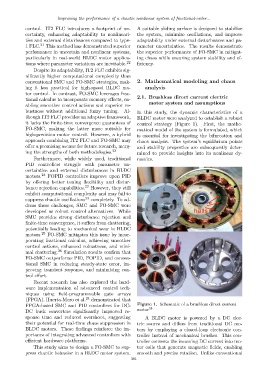
            FPGA-based SMC and PID controllers for DC-        Figure 1. Schematic of a brushless direct current
                                                                   25
            DC buck converters significantly improved re-     motor
            sponse time and reduced overshoot, suggesting         A BLDC motor is powered by a DC elec-
            their potential for real-time chaos suppression in  tric source and differs from traditional DC mo-
            BLDC motors. These findings reinforce the im-     tors by employing a closed-loop electronic con-
            portance of integrating advanced controllers with  troller instead of mechanical brushes. This con-
            efficient hardware platforms.                     troller converts the incoming DC current into mo-
                This study aims to design a FO-SMC to sup-    tor coils that generate magnetic fields, enabling
            press chaotic behavior in a BLDC motor system.    smooth and precise rotation. Unlike conventional
                                                           381

