


Page 13 - IJOCTA-15-3
P. 13
Improving the performance of a chaotic nonlinear system of fractional-order...
            3. Control strategy for chaos                         Furthermore, Figures 4 and 5 present the
                suppression                                   chaotic state trajectories of the FO-BLDC sys-
                                                              tem without a control signal.
            This study considers the following assumptions to
            ensure the accurate modeling and practical fea-
            sibility of the proposed FO-SMC for the BLDC
            system.


                                                              s


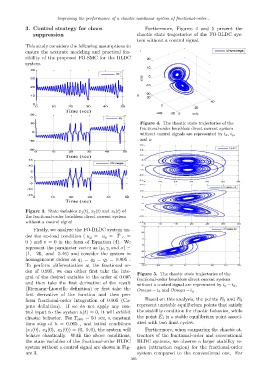
                                                               Figure 4. The chaotic state trajectories of the
                                                               fractional-order brushless direct current system
                                                               without control signals are represented by i d , i q ,
                                                               and ω


            Figure 3. State variables x 1 (t), x 2 (t) and x 3 (t) of
            the fractional-order brushless direct current system
            without a control signal
                Firstly, we analyze the FO-BLDC system un-
            der the no-load condition ( u = u q = T L =
                                                     f
                                         d
            0 ) and v = 0 in the form of Equation (4). We
            represent the parameter vector as (µ, γ, and σ) =
            (1,  20, and 5.46) and consider the system in
            homogeneous orders as q 1 = q 2 = q 3 = 0.995 .
            To perform differentiation at the fractional or-
            der of 0.995, we can either first take the inte-
                                                              Figure 5. The chaotic state trajectories of the
            gral of the desired variable to the order of 0.005
                                                              fractional-order brushless direct current system
            and then take the first derivative of the result  without a control signal are represented by i q − i d ,
            (Riemann–Liouville definition) or first take the
                                                              Omega − i d and Omega − i q
            first derivative of the function and then per-
            form fractional-order integration of 0.005 (Ca-       Based on this analysis, the points E 2 and E 3
            puto definition). If we do not apply any con-     represent unstable equilibrium points that satisfy
            trol input to the system u(t) = 0, it will exhibit  the stability condition for chaotic behavior, while
            chaotic behavior. For T sim = 50 sec, a constant  the point E 1 is a stable equilibrium point associ-
            time step of h = 0.005 , and initial conditions   ated with two limit cycles.
            (x 1 (0), x 2 (0), x 3 (0)) = (0, 0, 0), the system will  Furthermore, when comparing the chaotic at-
            behave chaotically. With the above conditions,    tractors of the fractional-order and conventional
            the state variables of the fractional-order BLDC  BLDC systems, we observe a larger stability re-
            system without a control signal are shown in Fig-  gion (attraction region) for the fractional-order
            ure 3.                                            system compared to the conventional one. For
                                                           385

