


Page 16 - IJOCTA-15-3
P. 16
A. Kaveh, M. Vahedi, M. Gandomkar / IJOCTA, Vol.15, No.3, pp.379-395 (2025)
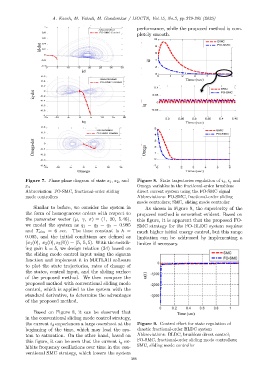
                                                              performance, while the proposed method is com-
                                                              pletely smooth.


            Figure 7. Phase plane diagram of state x 1 , x 2 , and  Figure 8. State trajectories regulation of i d , i q and
                                                              Omega variables in the fractional-order brushless
            x 3
            Abbreviation: FO-SMC, fractional-order sliding    direct current system using the FO-SMC signal
            mode controllers                                  Abbreviations: FO-SMC, fractional-order sliding
                                                              mode controllers; SMC, sliding mode controller
                Similar to before, we consider the system in      As shown in Figure 9, the superiority of the
            the form of homogeneous orders with respect to    proposed method is somewhat evident. Based on
            the parameter vector (µ, γ, σ) = (1, 20, 5.46),   this figure, it is apparent that the proposed FO-
            we model the system as q 1 = q 2 = q 3 = 0.995    SMC strategy for the FO-BLDC system requires
            and T sim = 6 sec. The time constant is h =       much higher initial energy control, but this range
            0.005, and the initial conditions are defined as  limitation can be addressed by implementing a
            (x 1 (0), x 2 (0), x 3 (0)) = (5, 5, 5). With the switch-  limiter if necessary.
            ing gain k = 5, we design relation (34) based on
            the sliding mode control input using the signum
            function and implement it in MATLAB software
            to plot the state trajectories, rates of change of
            the states, control input, and the sliding surface
            of the proposed method. We then compare the
            proposed method with conventional sliding mode
            control, which is applied to the system with the
            standard derivative, to determine the advantages
            of the proposed method.

                Based on Figure 8, it can be observed that
            in the conventional sliding mode control strategy,
            the current i d experiences a large overshoot at the  Figure 9. Control effort for state regulation of
            beginning of the time, which may lead the sys-    chaotic fractional-order BLDC system
            tem to saturation. On the other hand, based on    Abbreviations: BLDC, brushless direct control;
            this figure, it can be seen that the current i q ex-  FO-SMC, fractional-order sliding mode controllers;
                                                              SMC, sliding mode controller
            hibits frequency oscillations over time in the con-
            ventional SMC strategy, which lowers the system
                                                           388

