


Page 21 - IJOCTA-15-3
P. 21
Improving the performance of a chaotic nonlinear system of fractional-order...
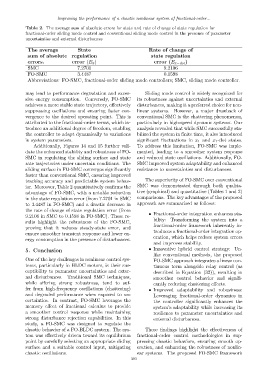
            Table 2. The average sum of absolute errors for state and rate of change of state regulation for
            fractional-order sliding mode control and conventional sliding mode control in the presence of parameter
            uncertainties and external disturbances

             The average            State                          Rate of change of
             sum of absolute regulation                             state regulation
             errors.             error (E x )                         error (E x−dot )
             SMC                   7.2701                                 9.2106
             FO-SMC                3.4487                                 0.1598
             Abbreviations: FO-SMC, fractional-order sliding mode controllers; SMC, sliding mode controller.

            may lead to performance degradation and exces-        Sliding mode control is widely recognized for
            sive energy consumption. Conversely, FO-SMC       its robustness against uncertainties and external
            achieves a more stable state trajectory, effectively  disturbances, making it a preferred choice for non-
            suppressing oscillations and ensuring faster con-  linear systems. However, a major drawback of
            vergence to the desired operating point. This is  conventional SMC is the chattering phenomenon,
            attributed to the fractional-order terms, which in-  particularly in high-speed dynamic systems. Our
            troduce an additional degree of freedom, enabling  analysis revealed that while SMC successfully sta-
            the controller to adapt dynamically to variations  bilized the system in finite time, it also introduced
            in system parameters.                             significant fluctuations in x 1 and x 1 -dot states.
                Additionally, Figures 14 and 15 further vali-  To address this limitation, FO-SMC was imple-
            date the enhanced stability and robustness of FO-  mented, leading to a smoother system response
            SMC in regulating the sliding surface and state   and reduced state oscillations. Additionally, FO-
            rate trajectories under uncertain conditions. The  SMC improved system adaptability and enhanced
            sliding surface in FO-SMC converges significantly  resistance to uncertainties and disturbances.
            faster than conventional SMC, ensuring improved
            tracking accuracy and predictable system behav-       The superiority of FO-SMC over conventional
            ior. Moreover, Table 2 quantitatively confirms the  SMC was demonstrated through both qualita-
            advantage of FO-SMC, with a notable reduction     tive (graphical) and quantitative (Tables 1 and 2)
            in the state regulation error (from 7.2701 in SMC  comparisons. The key advantages of the proposed
            to 3.4487 in FO-SMC) and a drastic decrease in    approach are summarized as follows:
            the rate of change of state regulation error (from
            9.2106 in SMC to 0.1598 in FO-SMC). These re-          • Fractional-order integration enhances sta-
            sults highlight the robustness of the FO-SMC,            bility: Transforming the system into a
            proving that it reduces steady-state error, and          fractional-order framework inherently in-
            ensure smoother transient response and lower en-         troduces a fractional-order integration op-
            ergy consumption in the presence of disturbances.        eration, which helps reduce system errors
                                                                     and improves stability.
            5. Conclusion                                          • Innovative hybrid control strategy: Un-
                                                                     like conventional methods, the proposed
            One of the key challenges in nonlinear control sys-      FO-SMC approach integrates a linear con-
            tems, particularly in BLDC motors, is their sus-         tinuous term alongside relay control (as
            ceptibility to parameter uncertainties and exter-        described in Equation (32)), resulting in
            nal disturbances. Traditional SMC techniques,            smoother control behavior and signifi-
            while offering strong robustness, tend to suf-           cantly reducing chattering effects.
            fer from high-frequency oscillations (chattering)      • Improved adaptability and robustness:
            and degraded performance when exposed to un-             Leveraging fractional-order dynamics in
            certainties. In contrast, FO-SMC leverages the           the controller significantly enhances the
            memory effect of fractional calculus to provide          system’s adaptability while increasing its
            a smoother control response while maintaining            resilience to parameter uncertainties and
            strong disturbance rejection capabilities. In this       external disturbances.
            study, a FO-SMC was designed to regulate the
            chaotic behavior of a FO-BLDC system. The sys-        These findings highlight the effectiveness of
            tem was effectively driven toward its equilibrium  fractional-order control methodologies in sup-
            point by carefully selecting an appropriate sliding  pressing chaotic behaviors, ensuring smooth op-
            surface and a suitable control input, mitigating  eration, and enhancing the robustness of nonlin-
            chaotic oscillations.                             ear systems. The proposed FO-SMC framework
                                                           393

